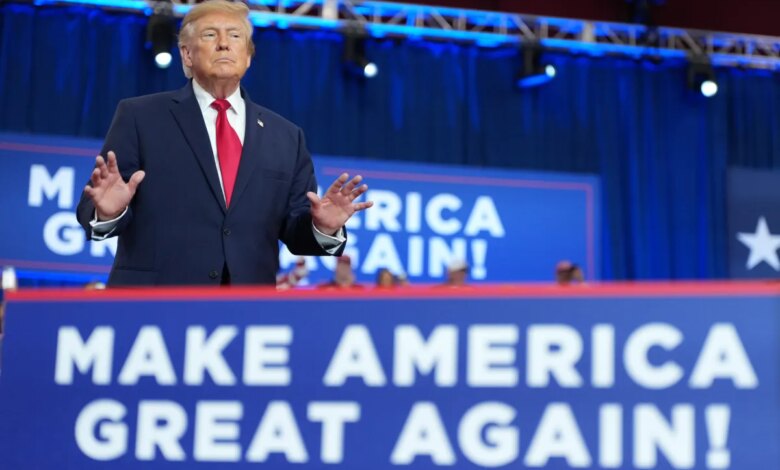
During a campaign rally in Texas, Donald Trump presented a major economic proposal tied to the outcome of the upcoming midterm elections, promising a $5,000 payment to every adult U.S. citizen if Republicans secure control of both the House of Representatives and the Senate. The proposal, which the administration has termed the “Trump Dividend,” became the centerpiece of a speech that balanced populist economic promises with a lighthearted acknowledgment of the costs associated with his own private properties.
While addressing the crowd, Trump joked that the promised $5,000 would not stretch very far at his Mar-a-Lago club in Palm Beach, Florida. After inviting his supporters to visit the resort as his guests, he quipped that even with such a payment, “the most you’ll be able to buy is a hamburger and maybe a small dessert.” He further questioned whether the $5,000 would cover even those items, suggesting to the audience that Mar-a-Lago is perhaps not the best destination for those who are “price conscious.”
The proposed dividend comes as household expenses remain the dominant concern for the American electorate. Recent polling indicates a sharp focus on the cost of living, with one survey finding that 34 percent of likely voters cite it as their primary concern heading into the midterms. Another study found that as many as 84 percent of voters view the cost of living as one of the most critical factors in their decision-making process. Trump has framed the dividend as a way to return money to Americans, arguing that his policies are driving broader economic improvements.
However, the scale of the “Trump Dividend” carries significant fiscal implications. With approximately 240 million adult citizens in the United States, the estimated cost of the program would reach roughly $1.2 trillion. This figure dwarfs previous targeted payments, such as the $1,776 “warrior dividend” distributed to military service members in 2025. Unlike that earlier program, which utilized a housing supplement already authorized by Congress, the proposed $5,000 payment currently lacks a legislative framework or a formal distribution plan.
As of now, the administration has not provided specific details on how the program would be implemented. Key questions remain regarding the application process, the timeline for distribution, and whether income limits would be used to phase out payments for wealthier citizens. Furthermore, the entire proposal remains contingent on a Republican sweep of Congress, as the executive branch cannot authorize such a massive expenditure without a mandate from the House and Senate.
Despite the lack of technical specifics, Trump has used the promise to sharpen the stakes of the November midterms. By linking a direct cash benefit to the electoral outcome, he is seeking to capitalize on the economic anxieties that continue to shape the political landscape in the closing days of the campaign.