Zhou Qunfei, the “Glass Queen” of China’s technology sector, has once again ascended to the top of the nation’s wealth rankings. However, her return to the summit of the 2026 Hurun Richest Women list coincides with a period of severe financial contraction for her flagship company, Lens Technology. A major supplier in the Apple ecosystem, Lens Technology is currently grappling with a sharp decline in profitability while aggressively pivoting its business toward artificial intelligence and high-performance computing hardware.
According to the company’s third-quarter report for 2026, Lens Technology saw its net profit nearly halve during the first nine months of the year. The company recorded a net profit of 1.42 billion RMB (approximately $195 million), a 50.06 percent decrease compared to the same period last year. Revenue for the three quarters totaled 47.902 billion RMB, representing a year-over-year decline of 10.74 percent. This downward trend, which began in late 2025, reflects the cooling demand in the company’s traditional strongholds: the smartphone and personal computer markets.
The financial results highlight a volatile year for the glass titan. After finishing 2025 with a 6.23 percent dip in quarterly profit, Lens Technology entered 2026 with a net loss of 150 million RMB in the first quarter. While the company briefly returned to growth in the second quarter, the third quarter saw another sharp reversal, with net profits falling 50.42 percent to 843 million RMB—down from 1.7 billion RMB in the third quarter of 2025. Additionally, the company’s financial expenses ballooned by 1,068 percent during the reporting period, reaching 716 million RMB, a spike primarily attributed to significant foreign exchange losses.

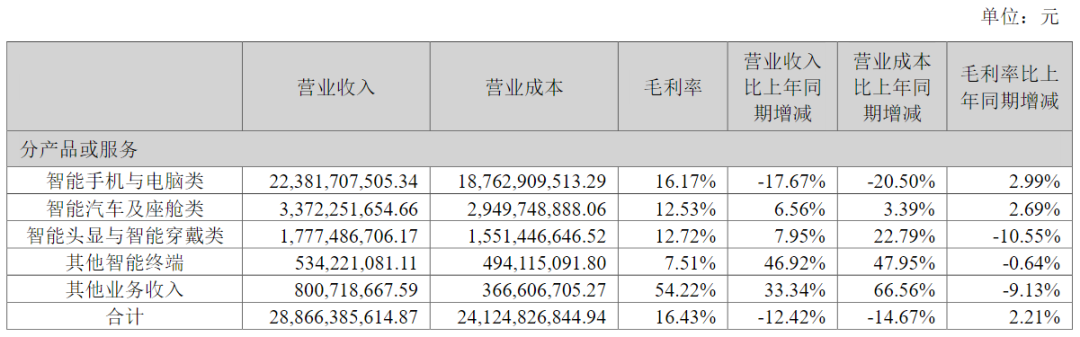
For years, Lens Technology’s primary growth engine has been its “Fruit Chain” relationship with Apple, a partnership that began in 2006 when Zhou Qunfei successfully pitched her glass screens for the original iPhone. By 2024, the smartphone and computer segment accounted for over 82 percent of total revenue, generating 57.75 billion RMB. However, that growth engine has stalled. In 2025, revenue growth in this core segment plummeted to just 5.94 percent, down from 28.63 percent the previous year. By the first half of 2026, revenue from smartphones and computers dropped 17.67 percent to 223.82 billion RMB.
Management cited several factors for the slump, including a prolonged replacement cycle among consumers and a major supply-demand gap in the memory chip market that drove up terminal prices. Global data confirms the broader industry struggle, with significant year-over-year declines in smartphone and laptop shipments throughout 2026. In response, Lens Technology has shifted its focus toward higher-margin products, such as assembly services for professional-grade sports cameras and high-end consumer electronics, to offset the losses in its lower-margin traditional glass business.
Despite the current financial headwinds, Zhou Qunfei—whose personal fortune is estimated at nearly 1300 billion RMB—is doubling down on a strategic shift toward AI computing hardware. On October 16, the company announced a $25 million (172 million RMB) cash acquisition for a 59.78 percent stake in PMG. The move is highly strategic; PMG’s subsidiary, Zhejiang Yuanshi, is one of the few suppliers globally to hold Nvidia’s RVL certification for server cabinets.
Zhejiang Yuanshi is already supplying core components like MGX racks and slide rails for Nvidia’s GB200 and GB300 series servers and is reportedly involved in the development of the next-generation Vera Rubin server platform. Analysts suggest this acquisition serves as a critical entry point into the global AI computing supply chain, allowing Lens Technology to transition from a consumer electronics components manufacturer into a key infrastructure provider for the generative AI era.
Beyond server hardware, Lens Technology is exploring advanced material science to maintain its competitive edge. In July, the company announced a collaboration with Intel to explore Through Glass Via (TGV) packaging technology. TGV glass substrates are increasingly viewed as the ideal material for the next generation of AI chip packaging due to their thermal stability and low signal loss. With the global market for glass substrates expected to reach $18.6 billion by 2026 and potentially $32 billion by 2030, Lens Technology is positioning itself to be at the forefront of what industry experts call the “commercialization year” of glass-based computing architecture.
While newer business segments like smart car cockpits and wearable tech showed modest growth in the first half of 2026—rising 6.56 percent and 7.95 percent respectively—they remain a small fraction of the company’s total revenue. The “Other Smart Terminals” segment, which includes the emerging robotics business, grew by nearly 47 percent, but currently accounts for less than 2 percent of the company’s portfolio. For now, the challenge for Zhou Qunfei remains balancing the decline of the smartphone era with the massive capital requirements of the AI future, all while maintaining her position as the most successful self-made woman in the industry.