At least 64 people were killed on Wednesday when two high-speed trains collided near Toledo in central Spain, triggering a massive rescue operation and intensifying scrutiny over the nation’s rail network infrastructure. The disaster occurred just nine months after a similar fatal crash on the same line, prompting an official three-day mourning period in Andalusia and raising pointed questions for transport officials.
The collision took place when a high-speed train operated by national rail company Renfe struck a stationary train operated by private consortium Iryo. According to a person briefed on the disaster, the Iryo service had stopped near Toledo on orders from infrastructure manager ADIF following a computer communications failure that automatically halted traffic and triggered an active red signal.
Addressing reporters in Madrid, Transport Minister Oscar Puente disclosed that an erroneous decision was made to restart the Renfe train, authorizing it to continue its journey despite the active red signal due to the stationary train on the tracks ahead. Puente stated that the incident occurred because protocol was broken, though he insisted to the public that the broader railway system remains reliable and safe while acknowledging it has limits like any transport network. When pressed by reporters in Madrid, Puente refused to answer whether he would resign.
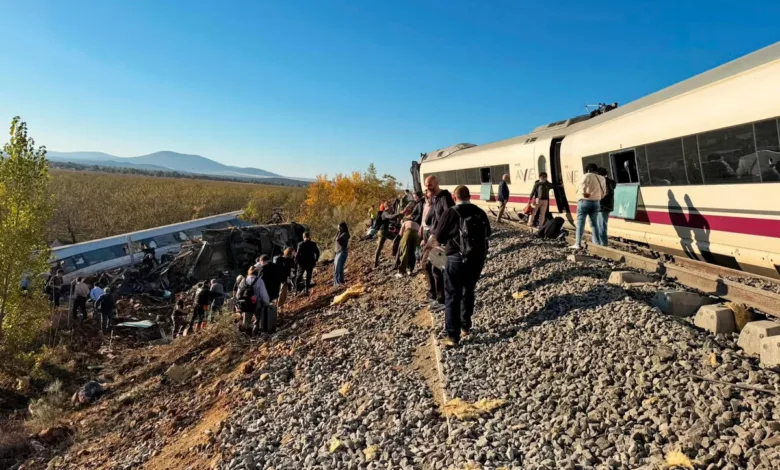
The impact sent several carriages of both trains derailing. Wreckage, twisted metal, and broken panels were strewn across an embankment beneath the elevated section of track where at least three carriages had plunged downward. Hundreds of emergency workers, ambulances, funeral home vans, and helicopters converged on the site in Urda, Spain. Evacuated passengers streamed along a nearby road, some with bandaged wounds or blood-splattered clothing, wheeling suitcases and receiving water donated from neighboring towns and handed out by volunteers.

Regional politician Juanma Moreno announced that Andalusia would enter a three-day official mourning period starting at 2 p.m. Wednesday through 2 p.m. on Saturday, October 31. Moreno expressed devastation on behalf of the region, stating that all of Andalusia stands with the victims of the tragedy.
The catastrophe is the second deadly rail accident in less than a year on Spain’s high-speed lines, following a January 18 crash near Adamuz in the province of Cordoba where 46 people died and more than 120 were injured when a high-speed train derailed and collided with an oncoming one. Data from Spain’s railway safety authority indicates that overall accidents, including derailments and collisions, rose from 45 in 2016 to 57 in 2024 and 69 last year. Meanwhile, European Commission data shows that while Spain spent an average of about €1.5 billion a year from 2018 to 2022 on its high-speed network—more than any other European country—the vast majority went toward new infrastructure, with only roughly 16% earmarked for maintenance, renewal, and upgrades across its approximately 4,000 kilometers of high-speed lines.