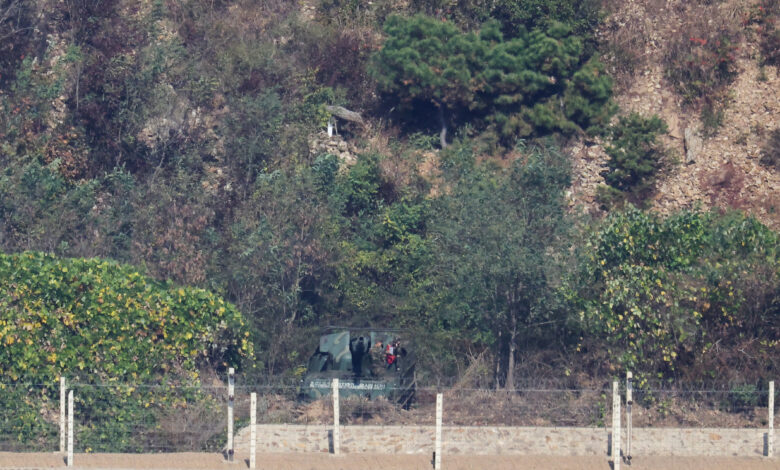
Visitors to a South Korean observation deck overlooking North Korea expressed growing concern on Tuesday over the visible deployment of North Korean artillery pieces with their barrels pointed directly south, as military tensions along the heavily fortified border continue to escalate.
The two Koreas have engaged in verbal clashes and reinforced their military postures along the Demilitarised Zone since September, following a landmine explosion that wounded three South Korean soldiers. Seoul has demanded an official apology from Pyongyang, while North Korean authorities have accused South Korea of fabricating the incident.
The security climate has further deteriorated in recent days following statements from Kim Yo Jong, the influential sister of North Korean leader Kim Jong Un. Last Thursday, she announced that Pyongyang would place loudspeakers capable of broadcasting anti-South Korean propaganda on standby along the entire border within days and stated that unspecified new countermeasures had been put on alert.
Visual evidence of the military buildup emerged late last week. On Friday, South Korean media photographed an armored vehicle stationed in clear view near the frontier. By Monday, three such vehicles had been spotted with their gun barrels trained south, according to witness reports.
For visitors touring the border region, the physical proximity of the weaponry brought underlying geopolitical hostilities into sharp focus. Outside the Aegibong observatory in Gimpo, which overlooks North Korea’s Kaephung county from a distance of about 1.4 kilometers, 83-year-old Vietnam War veteran Jang Gil-seong reflected on the immediate reality of the threat. He noted that while he had previously seen reports of North Korean 122-millimeter artillery deployments on television, viewing the equipment in person underscored the gravity of the situation and raised questions about future defense preparations.
Despite periodic flare-ups in tensions between the neighboring countries, which remain technically at war, the DMZ continues to draw both local and foreign tourists. Canadian tourist Hannah Robbins, 28, explained that her tour group only learned of the artillery placement after their guide briefed them at the observatory. She acknowledged that while the guide attempted to reassure visitors by saying the weapons would not be fired, the presence of the deployed hardware remained a source of unease.
Military experts and defense officials have identified the deployed hardware as M-1981 122-millimeter self-propelled howitzers, an older artillery system that entered service in the late 1970s. Yang Uk, a military expert at Seoul’s Asan Institute for Policy Studies, noted that the weapons have a maximum range of approximately 24 kilometers, or 15 miles, placing areas such as Gimpo within potential striking distance. However, Yang observed that the systems are less powerful than newer North Korean armaments and interpreted the deployment as a psychological display rather than a significant tactical upgrade.
“I would view this more as a display of firepower than a meaningful increase in combat capability,” Yang said, adding that positioning the weapons in plain sight suggested they were meant to be noticed.
South Korea’s military echoed that assessment during a briefing on Tuesday. Addressing reporters, Joint Chiefs of Staff spokesperson Jang Do-young noted that although North Korea has referenced newer weapon systems in recent public statements, the visible hardware cannot be classified as such.