QatarEnergy, the state-owned energy enterprise exporting tens of billions of dollars in liquefied natural gas, petrochemicals, urea, and ammonia annually, has been orchestrating lobbying campaigns targeting U.S. trade groups on behalf of the Qatari government. Rather than engaging federal officials directly under strict transparency mandates, the energy firm leveraged American non-governmental organizations to petition the Office of the U.S. Trade Representative for tariff exemptions.
Under federal guidelines, individuals or entities lobbying directly on behalf of a foreign principal must register under the Foreign Agents Registration Act and explicitly disclose their activities, contacts, and timelines. By reaching out to domestic trade associations and encouraging those groups to advocate on its part, QatarEnergy navigated a distinct procedural grey area. The intermediary organizations submitted their requests to federal regulators before QatarEnergy disclosed its lobbying involvement, leaving open the possibility that the USTR remained unaware it was indirectly processing a foreign government’s petition when it ultimately granted an exemption for ammonia.
Regulatory filings from QatarEnergy indicate that its board of directors is appointed by the Emir of the State of Qatar and accounts to both the Supreme Council for Economic Affairs and Investment and the Council of Ministers. The corporation’s chief executive officer, Saad Sherida Al-Kaabi, serves concurrently as Qatar’s Minister of State for Energy Affairs, with other board members holding prominent government posts.
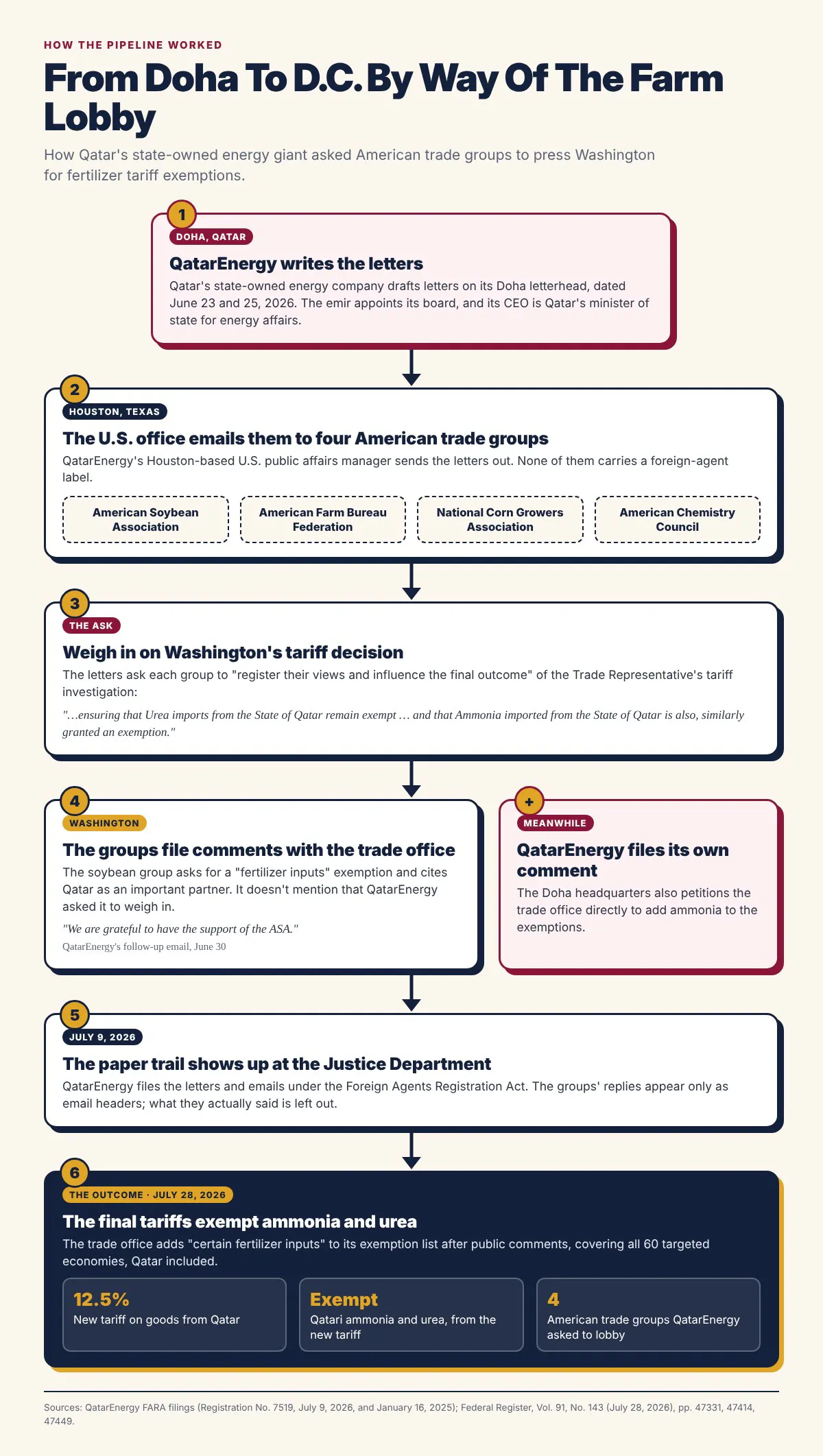
When the Texas-based branch of QatarEnergy contacted domestic agricultural and chemical organizations, it transmitted correspondence originating from its Doha headquarters. A communication forwarded to the American Soybean Association urged the group to leverage its influence with American policymakers to ensure that Qatari urea and ammonia imports remained exempt under final USTR rulings. The soybean association subsequently petitioned the federal government for these fertilizer input exemptions, citing Qatar as a vital commercial partner, but did not inform regulators that QatarEnergy had prompted the request. While legally mandated FARA filings from QatarEnergy redacted the association’s specific response, an organizational representative stated that its advocacy stance on agricultural inputs remained consistent regardless of outside correspondence.
Internal correspondence reflects gratitude for the advocacy efforts. In a June 24 message, QatarEnergy representative Marcus Lee thanked Alexa Combelic, the executive director of government affairs for the soybean association, for the organization’s support on tariff matters.
Beyond the soybean association, QatarEnergy reached out to several other prominent U.S. entities, including the American Chemistry Council, the American Farm Bureau Federation, and the National Corn Growers Association. While the farm bureau and corn growers did not formally request specific Gulf or Qatari fertilizer exemptions, QatarEnergy nonetheless expressed appreciation for their broader support. Alongside these indirect efforts, QatarEnergy also petitioned the USTR directly concerning ammonia exemptions, joining numerous other foreign nations seeking similar trade relief.