As President Donald Trump nears the halfway point of his second term, a looming question animates Republican circles: Can the MAGA movement survive without him, and who will shape its future? To answer that, some younger conservatives belonging to the so-called New Right are reaching back decades for inspiration, initiating an image rehabilitation campaign for the 37th U.S. president known as “Nixonmaxxing.”
In June, Vice President JD Vance spoke at the Richard Nixon Presidential Library and Museum in Yorba Linda, California, minimizing the gravity of the scandal that forced Nixon from office in 1974. Vance suggested that if Watergate were to occur today, it would barely register as a brief news cycle, calling the idea that it could toppled a presidency crazy.
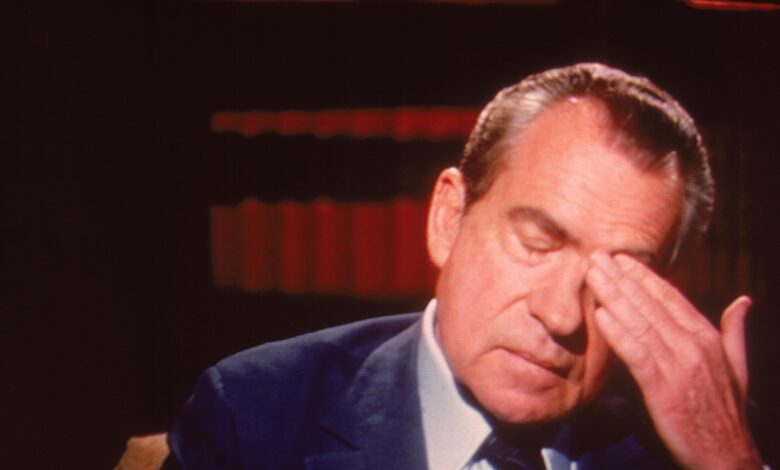
Watergate remains the defining political scandal in American history, giving rise to the ubiquitous suffix used for modern political controversies. The crisis began in June 1972 when operatives linked to Nixon’s reelection campaign were caught breaking into the Democratic National Committee headquarters at the Watergate complex in Washington, D.C. Subsequent congressional investigations and a vast trove of White House audio recordings revealed Nixon’s complicity in the cover-up, prompting his resignation in August 1974 ahead of almost certain impeachment and removal.
Yet proponents of “Nixonmaxxing” view this history through a fundamentally different lens. They portray Nixon as a martyr felled by the “deep state”—an entrenched network of unelected bureaucrats that conservative activists believe also sought to undermine Trump’s first term and continues to do so today.
Michael Koncewicz, associate director of New York University’s Institute for Public Knowledge and a political historian, notes that this revisionism serves a strategic purpose for modern conservative activists. By attempting to dismantle the traditional narrative that Watergate was a moment when democratic institutions successfully rooted out corruption, these activists hope to inoculate current and future leaders against potential scandals.

“Conservative activists want you to believe that that’s not true,” Koncewicz explains. “And the main reason is that if they can make you believe that that’s a lie, then they can make you question any future scandal that could affect any one of their guys.”
To understand Nixon’s appeal to contemporary figures like Vice President Vance and activist Christopher Rufo, historians point to the roots of the scandal in the summer of 1971. Enraged by the leak of the Pentagon Papers—a classified Vietnam War history compiled under the Johnson administration—Nixon authorized the creation of the White House Special Investigations Unit, commonly known as the “Plumbers.” Staffed by operatives with CIA and FBI backgrounds experienced in covert operations, the unit’s first mission involved breaking into the office of Daniel Ellsberg’s psychiatrist. Although undetected at the time, this operation established a pattern of clandestine activity that eventually led to the bungled DNC break-in.
While initial public reaction dismissed the 1972 arrests as a minor third-rate burglary disconnected from the White House, the Oval Office tapes later proved Nixon knew about the unit and its activities. As public awareness grew in 1973, Nixon’s approval rating plummeted to 25 percent. Facing an imminent bipartisan vote for impeachment in the House and conviction in the Senate, Nixon chose to resign.
Despite this historical record, figures like Rufo and Vance find much to admire in Nixon’s aggressive behind-the-scenes posture. Unlike previous post-WWII presidents, Nixon sought to micromanage executive power as a tool for culture warfare, aiming to weaken liberal influence across American institutions, particularly in academia and the media. Vance notably quoted Nixon during a late 2021 Senate campaign speech at the National Conservatism Conference, invoking a famous Nixon directive regarding university faculty: “The professors are the enemy. Professors are the enemy. Write that on the blackboard 100 times and never forget it.”
Such open admiration would have been politically unthinkable for mainstream conservative politicians just a few years ago. Today, however, as the Republican Party looks toward a post-Trump era, the embrace of Nixon’s combative legacy signals a shifting ideological baseline.
Whether Nixonmaxxing will become a dominant force in American politics remains an open question. Historians point out that Nixon is still widely regarded as one of the most corrupt presidents in U.S. history, and public perception of Watergate as an exceptional constitutional crisis largely persists. However, experts caution that the deeper challenge lies in the degradation of America’s political culture. While the system worked in 1974, it did so because civic institutions, bipartisan norms, and a shared culture of dissent were far stronger than they are in today’s intensely polarized environment.