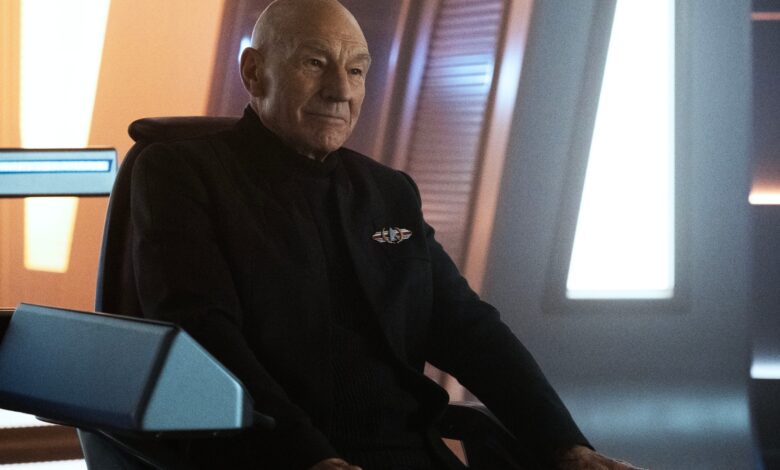
Sir Patrick Stewart, whose commanding presence as Captain Jean-Luc Picard transformed television science fiction and brought theatrical gravitas to the small screen, died Wednesday in Los Angeles at 86.
Before taking on his signature seven-year mission in “Star Trek: The Next Generation,” television was widely regarded in Hollywood as cinema’s inferior cousin, with syndicated science fiction holding an even lower status. But Stewart, largely unknown to American audiences outside of appearances in John Boorman’s “Excalibur” and David Lynch’s “Dune,” approached the role of the USS Enterprise commander with the discipline of a Shakespearean protagonist. As Picard, he embodied franchise creator Gene Roddenberry’s humanist vision—offering a paragon of grace, empathy, and intellectual curiosity who eschewed the swagger of his predecessor, James T. Kirk, in favor of philosophical debate, horseback riding, and fencing.
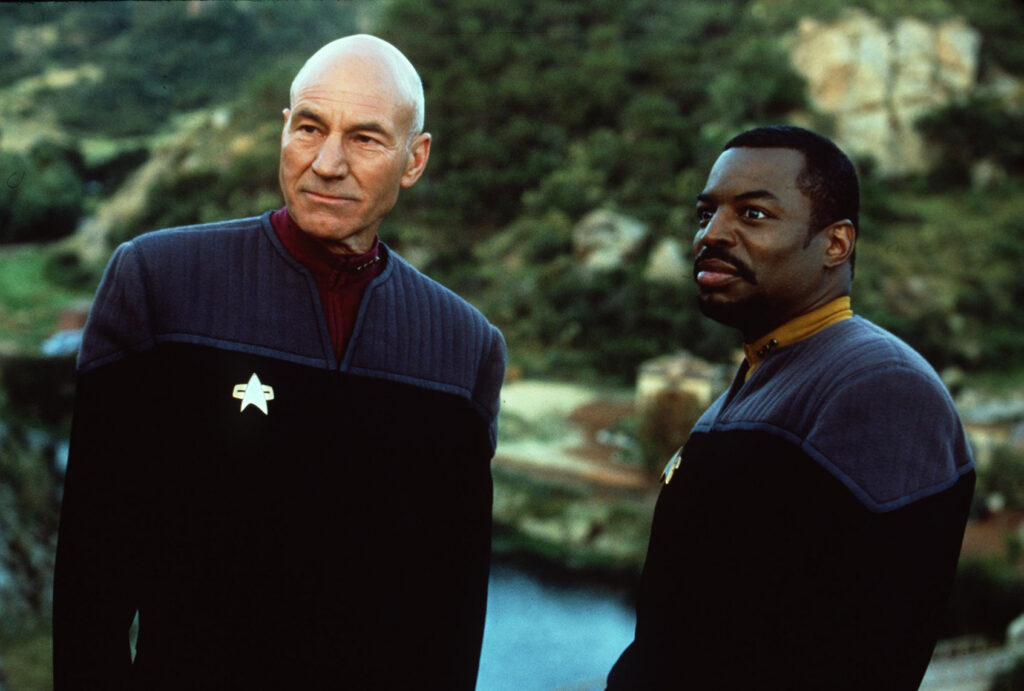
Born July 13, 1940, in a West Yorkshire industrial town, Stewart grew up in a home lacking an indoor toilet or running hot water. He trained at the Bristol Old Vic Theatre School after enrolling in 1957, shedding his working-class accent and winning his stage debut in a 1959 adaptation of “Treasure Island.” His foundational years were defined by 16 seasons with the Royal Shakespeare Company starting in 1966, followed by a tenure with the Royal National Theatre beginning in 1984. When a reporter once suggested he was slumming it by joining the science fiction franchise, Stewart offered a characteristically sharp retort. As cited by publication accounts, he replied that sitting in the captain’s chair of the Enterprise was “rather like sitting on the throne of England, though marginally more important.” Queen Elizabeth II formally conferred his knighthood in 2010.
Over 178 episodes of “The Next Generation,” alongside subsequent feature films and the later Paramount+ spinoff “Star Trek: Picard,” Stewart’s gravitas served as the gravitational center for a series that won 17 Emmy Awards and a Peabody. Even as catchphrases like “make it so” and “engage” became pop culture fixtures, the actor maintained a fierce commitment to the character’s moral core. By the time the final voyage of “Star Trek: Picard” debuted in 2020, the character had evolved from a traditional Starfleet hero into an admiral exhausted by politics and cruelty, reflecting broader cultural anxieties.
Stewart’s career extended far beyond the final frontier. His classical training fueled a versatile screen and voice career that included portraying the mutant telepath Professor Xavier in the “X-Men” film franchise, playing Gurney Halleck in “Dune,” and lending his distinctive baritone to animated comedies like “American Dad!” as Avery Bullock, as well as memorable guest turns on “Family Guy” and “Extras.” Despite the shadow cast by his most famous role, Stewart frequently embraced his association with Picard. Reflecting on the character during a 2020 Television Critics Association press conference, he noted that halfway through the third season of “The Next Generation,” the lines between actor and character dissolved. “We became melded, and he has never left me,” he said. “He has always been there, and it’s a relationship that I am happy to continue with.”