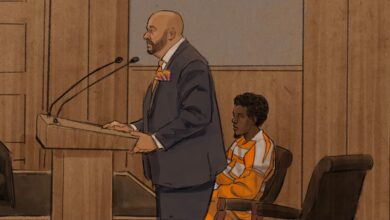
Three men convicted of plotting a terrorist attack against a mosque in Galway have been sentenced to prison terms by the Special Criminal Court in Dublin.
The group, operating under the self-styled title of the Irish Defence Army, had formulated advanced plans to bomb the Maryam Mosque on the Monivea Road between November 4 and 5, 2025. Law enforcement officers intervened and arrested the conspirators before the attack could be executed.

Garrett Pollock, 36, of Kilhorne Greene in Annalong, County Down, received a sentence of 10 and a half years, with the final year suspended. Pollock also entered a guilty plea for possessing an explosive substance discovered inside four glass jars hidden within a drawer in his van on November 4. Darren Gorman, 34, of O’Moore Place in Portlaoise, and Karolis Peckauskas, 39, of Newfoundwell Road in Drogheda, were each sentenced to eight years in prison with the final year suspended.
During sentencing on Friday, Ms Justice Caroline Biggs stated that modern Ireland is a multicultural and diverse society and that the actions of the convicted men brought shame upon the nation. Biggs characterized the offense as attempted arson intended to disseminate a terrorizing message worldwide, adding that evidence indicated the operation was planned as the initial strike in a projected series of attacks.

Detective Inspector Alan McDevitt previously testified that the conspirators belonged to a violent right-wing extremist faction that splintered from an online network named the Irish Citizens Army, communicating via the Signal messaging application. While authorities initially lacked precise scheduling for the intended assault, investigators seized an array of weapons and materials, including pipe bombs, improvised incendiary devices categorized as Molotov cocktails, five litres of bomb-usable chemicals, cable ties, hatchets, knives, masks, sunglasses, balaclavas, sealing putty, and an Irish flag.
Prior to their arrest, the defendants recorded a video on Pollock’s mobile phone inside Gorman’s kitchen in Portlaoise intended to claim responsibility for the bombing. The footage featured four masked individuals wearing tactical gear positioned before an Irish flag, announcing an intention to claim responsibility for the destruction of the first mosque introduced into the country in Galway.
Defense submissions and medical evaluations presented to the court detailed personal vulnerabilities among the offenders. Pollock, who submitted a written letter expressing remorse and shame, worked as a gym instructor. Evidence indicated he was rapidly radicalized online after struggling with alcohol and cocaine misuse, consuming emotive, ill-informed, and artificial intelligence-generated content concerning immigration. A medical assessment concluded Pollock acted amid emotional dysfunction, low self-esteem, and isolation, seeking a sense of belonging by demonstrating commitment to the extremist network.
Similarly, counsel for Gorman pointed to a psychological evaluation highlighting extreme submissiveness, vulnerability, substance addiction, and mental health challenges, emphasizing that Gorman possessed no prior history of violence, hatred, or terrorism.