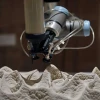
Data gathered by the Perseverance Mars rover over more than 1,600 Martian days is providing space agency engineers and flight surgeons with critical insights into the physical and chemical nature of Martian dust. The findings, published in the Proceedings of the National Academy of Sciences, offer new measurements of fine and ultrafine particles clinging to spacesuit material swatches carried aboard the rover, addressing a hazard that could affect future crewed missions to the red planet.
While previous surface observations resolved dust particles down to about 3 micrometers across, instruments aboard Perseverance detected two categories of even smaller particles. The Planetary Instrument for X-ray Lithochemistry, known as PIXL, identified fine particles measuring less than 2.5 micrometers—about 70 times thinner than a human hair—and ultrafine particles around 100 nanometers, roughly 700 times thinner than a hair. Particles on the instrument’s Teflon calibration target and a Vectran spacesuit swatch on the Scanning Habitable Environments with Raman and Luminescence for Organics and Chemicals instrument averaged about 2 micrometers. On other targets, dust particle sizes ranged down to approximately 100 to 300 nanometers.

Researchers found that static electricity plays a major role in determining which dust sizes adhere to specific surfaces. Dust grains acquire electrical charges as they collide in the atmosphere, and different materials on the calibration targets attract varying grain sizes. Organic polymers such as the Teflon used in spacesuit outer layers proved particularly effective at collecting fine dust, and these microscopic particles remained attached despite years of rover driving and drilling. Although Martian dust grains are less abrasive than lunar dust due to wind-driven rounding, they are enriched in sulfur, chlorine, iron, phosphorus, and silicon, while also containing calcium sulfate.
Exposure to particles of this scale carries established health risks. On Earth, particulate matter below 2.5 micrometers can penetrate deep into the lungs and enter the bloodstream, while ultrafine particles around 100 nanometers can travel from the nasal cavity directly to the brain along the olfactory nerve. Furthermore, Martian dust is composed largely of silicate minerals and carries chemically reactive compounds, including perchlorates that can disrupt thyroid function and reactive iron capable of inducing cellular damage.

Space agency officials noted that the data will help shape engineering standards long before the first human missions reach Mars. The findings can inform the selection of protective suit materials, anti-dust coatings, suitport designs that allow astronauts to enter a suit attached directly to a habitat exterior, and dual-chamber airlock configurations. Ground testing and technology demonstrations are already underway using lunar missions and vacuum chamber facilities as proving grounds to develop effective dust-mitigation tools and shield technologies.