In Kazakhstan’s modern capital of Astana, 22-year-old public relations student Yunna Kinereish navigates a dual identity. She identifies as a Kazakh German, rooted in local traditions and mentality while holding fast to her heritage. Kinereish is among the 223,000 ethnic Germans living in the Central Asian republic today, a community whose presence in the region stems directly from the upheavals of the 20th century.
From the 18th century onward, ethnic Germans had settled across the Russian empire following official incentives. However, after Nazi Germany invaded the Soviet Union in 1941, dictator Josef Stalin ordered the mass deportation of hundreds of thousands of ethnic Germans from Russia and Ukraine to remote regions like Siberia and Kazakhstan. Held collectively responsible for the actions of the Nazi regime and branded as spies and collaborators, more than a million people were displaced. Historical records indicate that at least 200,000 of those deportees died from starvation, forced labor, and the harsh conditions of expulsion.
Kinereish’s own family history is intertwined with these events. Her relatives were driven out of Kleinwärter, an ethnic German settlement in Ukraine. Seeking to keep this history alive, Kinereish recently performed in a youth theater production staged at Astana’s House of Friendship, bringing the experiences of her Russian German forebears to the stage. The House of Friendship serves as the hub for German culture in the city, financed primarily by the German government to offer language courses, social services, and educational programs focused on Soviet-era repression.
Beyond the theater, Kinereish documented the harrowing experiences of German women incarcerated in the Akmolinsk Camp for Wives of Traitors to the Motherland, better known as ALZhIR. During the Great Terror of the 1930s, the Soviet regime established its largest camp networks in Kazakhstan. ALZhIR alone processed 18,000 women imprisoned merely because their husbands had been convicted as enemies of the state. Among them were 167 ethnic German women.
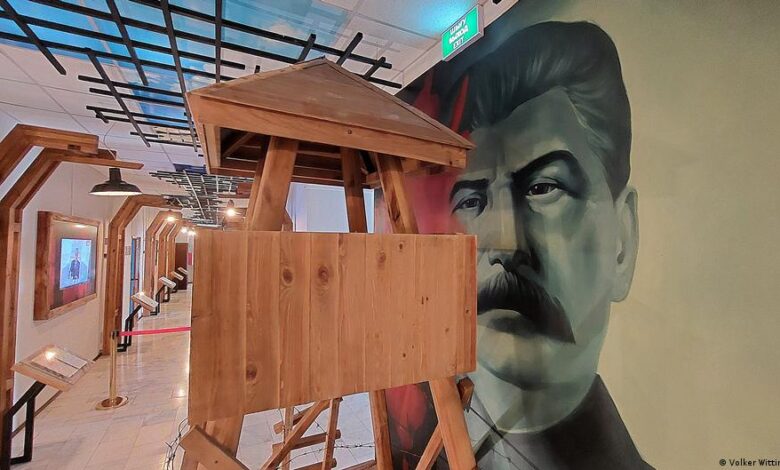
The memorial and museum for ALZhIR stand just outside Astana, past a sprawling landscape where rapid urban expansion gives way to the barren steppe. Visitors pass beneath the Arch of Grief—a massive steel structure commemorating the forced labor and suffering endured by the inmates—before entering a museum filled with prisoner artifacts, models of primitive quarters, and official documents.
Among the photographic exhibits is the story of Gertrud Platais, a print worker originally from Lower Silesia in modern-day Poland who became a Soviet citizen after marrying. Following her husband’s arrest in 1938, Platais was convicted as a relative of a traitor and sent to ALZhIR. There, enduring temperatures swinging from 40 degrees Celsius in summer to minus 40 degrees Celsius in winter, she was forced to work as an embroiderer until 1946. She was subsequently banished for life to the vast Karaganda Corrective Labor Camp, known as Karlag, and was not officially rehabilitated until 1956.
Karlag was the largest camp system in the region, operating as an immense economic and agricultural complex covering an area roughly 22 times the size of New York City. Between 1931 and 1959, nearly one million people passed through Karlag, with an estimated 10,000 prisoners dying between 1940 and 1950 alone from starvation, disease, and exhaustion.
The administrative headquarters of Karlag, located roughly 250 kilometers south of Astana near Karaganda, now houses a museum. While the building served administrative rather than punitive functions, visiting specialists note that the site now features reconstructed interrogation and torture cells paired with melodramatic loudspeaker music, presenting a heavily staged atmosphere that contrasts with its historical reality.
Both the ALZhIR and Karlag memorials attract relatively few visitors, reflecting a broader societal disconnect. Katherine M. Erdman, an American anthropologist and archaeologist at Nazarbayev University in Astana who has spent a decade researching the Gulag system, notes that public interest in confronting this brutal past remains limited.
Working with students using drone technology and ground interviews, Erdman’s research team has mapped how forced labor shaped the modern landscape, from factories built alongside primitive quarters to houses constructed with bricks manufactured by prisoners. However, researchers frequently encounter apathy or resistance from local populations and administrations. As the country pursues economic and social modernization, many residents prefer to look forward rather than reckon with the darker aspects of Soviet history.
Despite this widespread indifference, younger members of the Kazakh German community remain determined to ensure the past is not forgotten. For Kinereish, whose ancestors survived the Gulag system on Kazakh soil, the mission is personal. She emphasizes the importance of honoring her roots and passing down the suffering and endurance of her forebears to future generations.