The United States and Israel have drawn up detailed plans for renewed military strikes against Iran following the November 3 midterm elections. American forces are building up across the Middle East, and the Pentagon is quietly repositioning troops amid growing fears of potential Iranian retaliation.
The contemplated operations involve a short, intense military campaign potentially lasting three days. Targets would include Iran’s nuclear facilities, missile and drone arsenals, and energy infrastructure. Some military planners believe a concentrated offensive could inflict sufficient damage on Iran’s economy to force Tehran into concessions, though other officials question whether additional strikes would break the ongoing diplomatic deadlock.
American and Israeli forces have intensified joint exercises, including flights over Iraq to rehearse potential attacks. A substantial U.S. military deployment is expected to be in place by early November, bringing three aircraft carriers, thousands of Marines, additional fighter aircraft, and special operations forces into the region to expand President Donald Trump’s military options.
The timeline follows Trump’s pledge not to launch new American strikes before the November 3 elections. The president has not yet authorized another offensive and could ultimately decide against one.
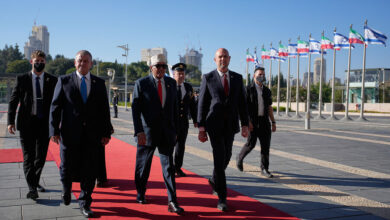
The preparations follow an unannounced visit to Israel by War Secretary Pete Hegseth, who met with Prime Minister Benjamin Netanyahu at Ovda Air Base to discuss the possibility of renewed strikes. Hegseth subsequently confirmed the meeting while declining to disclose specifics of the conversation, though he emphasized that American forces remain prepared to carry out additional operations if ordered.
“We want to make sure that Iran never gets a nuclear weapon. We’re prepared to contribute any way necessary,” Hegseth told reporters, noting that previous actions had inflicted historic devastation on Iranian military capabilities.
The high-level talks came a day after Trump endorsed Netanyahu ahead of Israel’s October 27 election, warning that Washington and Jerusalem would finish their campaign against Iran unless Tehran rapidly changed course. Trump cautioned that replacing Netanyahu could leave the United States to confront Tehran alone. During a subsequent conversation, Netanyahu reinforced the partnership, telling Trump they had a job to finish together.
Demonstrating military reach, dozens of Israeli fighter jets and refueling aircraft recently flew more than 800 miles through Syrian and Iraqi airspace toward Iran’s western border before turning back without entering Iranian airspace. Officials characterized the maneuver as a major demonstration of power and deterrence, with Israel notifying Washington in advance.
Prior to these developments, Netanyahu had proposed a substantially larger offensive around October 10 targeting nuclear facilities, power plants, and regime sites using an updated intelligence-based target list that exceeded the intensity of previous operations. Trump reportedly opposed resuming major hostilities before the midterms, and Israeli military sources have disputed aspects of the reported preparations.
Concurrently, the Pentagon has strengthened its regional posture while reducing the exposure of personnel stationed at vulnerable installations. American service members have been quietly moved from bases in Jordan, Qatar, and Kuwait as a precaution against possible retaliation, leaving smaller contingents behind to maintain air defenses and essential security operations. U.S. Central Command spokesman Capt. Timothy Hawkins stated that the military routinely adjusts deployments to maintain readiness.
Diplomatic missions have also taken protective measures. The State Department ordered the departure of non-emergency personnel and eligible family members from Saudi Arabia amid attacks by Yemen’s Iranian-backed Houthis, while other regional posts restricted operations.
Iranian officials have warned that another offensive could trigger retaliatory strikes on regional energy infrastructure, allied facilities, data centers, and undersea communications cables. An Iranian security official stated that the regime was prepared for an all-out, multi-layered war, rejecting any suggestions that Washington could dictate the duration or limits of a confrontation.
Amid the tensions, Pakistan’s army chief, Field Marshal Asim Munir, visited Tehran to revive mediation efforts, reportedly conveying an American warning demanding nuclear concessions or facing a large-scale attack, potentially targeting the heavily fortified Pickaxe Mountain nuclear facility. Deeply buried infrastructure at the site presents significant challenges for conventional bombing operations.
The core diplomatic impasse centers on Tehran’s refusal to accept Washington’s nuclear demands for eliminating its path to a nuclear weapon. Iranian officials are pressing for an end to the war, relief from the American blockade, and the reopening of the Strait of Hormuz before addressing substantive concessions. Maj. Gen. Mohsen Rezaei, secretary of Iran’s Supreme National Security Council, asserted that not a single gram of enriched uranium would be removed and demanded prior trust-building steps from Washington.
Netanyahu publicly called for the overthrow of Iran’s ruling regime during a military graduation ceremony, directing the Israel Defense Forces and intelligence branches to remove the threat once and for all. Trump maintained that the United States had already devastated Iran’s nuclear enrichment capacity through operations like Operation Midnight Hammer and Operation Epic Fury, but insisted that the gains must be made permanent to prevent Tehran from rebuilding its program in the years ahead.