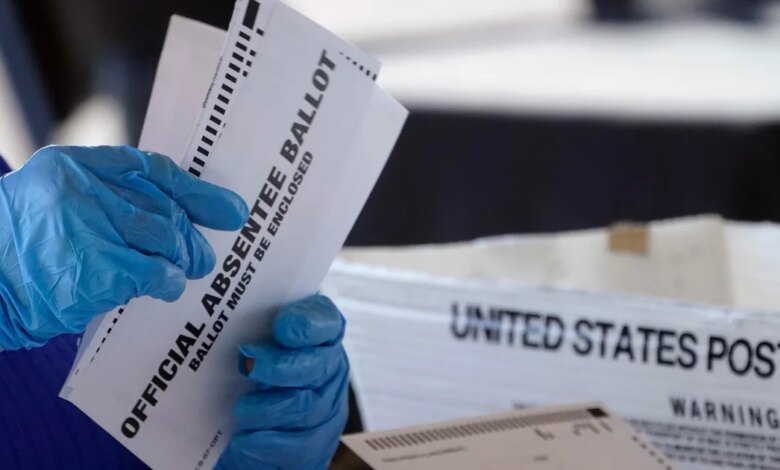
A federal judge on Wednesday rejected the Trump administration’s bid to require California election officials to separate mail ballots received from approximately 20,000 individuals the government claims are not U.S. citizens.
The decision from U.S. District Judge David Carter marks another setback for the administration in its efforts to exert federal oversight over state election administration ahead of midterm elections where voters will decide control of Congress. Carter ruled that the Justice Department’s request to segregate and exclude the ballots violates foundational constitutional principles that grant states the authority to administer their own elections.
“Never before in American history has the federal government, on the eve of an election, sought to coerce a state and local government to abandon their own Constitutional elections procedures and bend to the will of the Executive Branch,” Carter wrote in his 26-page decision. He warned that granting the relief sought by the administration could enable either political party to manufacture chaos for political purposes and disrupt the voting process.
More than 23 million voters are registered in California, where mail voting has been underway since early October. State officials reported that more than 3.5 million mail ballots have already been returned statewide. In Los Angeles County alone, more than 550,000 ballots have been processed.
The Justice Department filed its lawsuit earlier this month against California Secretary of State Shirley Weber and Los Angeles County Registrar-Recorder and County Clerk Dean Logan. The action followed letters giving election officials 48 hours to review a list of roughly 20,000 suspected noncitizens and ensure their ballots were not tabulated until citizenship could be confirmed.
During a hearing, Bill Essayli, the top federal prosecutor in Los Angeles, argued that California’s commingling of lawful ballots with those cast by alleged noncitizens thwarts congressional efforts to protect election integrity and risks diluting American votes. Essayli stressed that the administration was not asking to void or cancel ballots, but rather to sequester them while eligibility was verified.
State and local officials strongly opposed the demand. Anne Bellows, a deputy attorney general for California, denounced the lawsuit as a “reckless political stunt” designed to cast doubt on election results, calling the requested segregation an incredibly disruptive recipe for disenfranchisement.
Lawyers for Los Angeles County argued that manual review of ballot envelopes to identify the flagged voters would be impossible by the end of the election period and dismissed the government’s data as unreliable. County attorneys noted that of the 20,000 records on the federal list, just over 7,000 had addresses in Los Angeles County. A sample review of 200 records showed that more than half corresponded to registrations that were canceled or inactive, meaning no ballot was mailed. Furthermore, while Los Angeles County officials noted that just over 38 percent of a 200-voter sample reported being born in the U.S., a U.S. Citizenship and Immigration Services official stated in a court declaration that agency reviews of immigration records for those same 200 individuals determined none were born in the U.S. Nicolas Bartell, the USCIS official, also acknowledged that an ongoing analysis identified roughly 189 records with minor data discrepancies on the list sent to California.
Judge Carter echoed concerns regarding the accuracy of the federal list, writing that the administration’s methodology was vague and its verification protocol raised significant concerns. He noted that individuals meeting California’s voter registration requirements must not be deprived of their voting rights based on unfounded allegations stemming from an uncertain procedure.
Suggesting an alternative remedy during court proceedings, Carter asked prosecutors why they could not pursue post-election indictments using identifying information on returned ballot envelopes rather than risking the disenfranchisement of lawful voters.
The ruling followed a failed emergency appeal by the Justice Department to the U.S. Court of Appeals for the 9th Circuit, which voted 2-1 to dismiss the request because the administration failed to give the district judge adequate time to consider temporary relief. Following Wednesday’s district court ruling, the Justice Department filed a notice of appeal on the court docket.
The dispute in California forms part of a wider administrative push involving challenges in other regions, including Washington state, where prosecutors asked officials to set aside ballots from more than 400 alleged noncitizens, and Alaska, where the administration filed a lawsuit seeking to block certification of Senate election results.