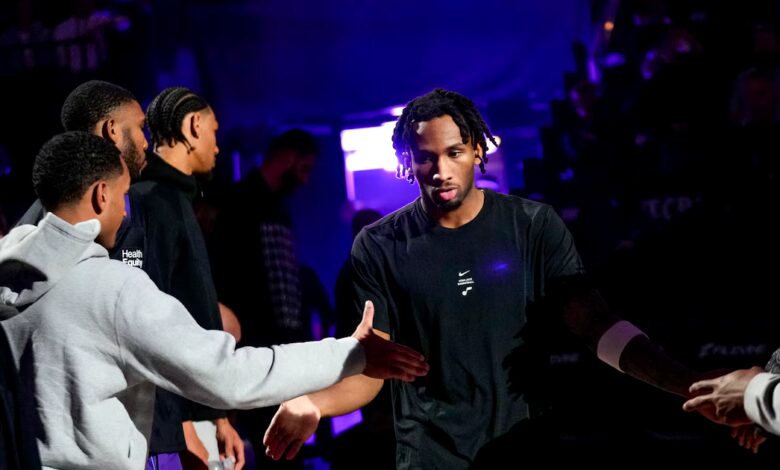
The 2026 NBA Draft class continues to generate extensive discussion as top selections navigate their debut seasons, offering glimpses of what could become a defining multi-year rivalry. During a recent matchup at the Delta Center on Monday, October 26, 2026, fans witnessed a brief yet telling exchange when Utah Jazz guard Darryn Peterson switched onto Memphis Grizzlies forward Cameron Boozer. The sequence saw both rookies test each other on defense, with Peterson forcing a missed mid-range fadeaway before Boozer responded on the following possession by contesting a driving shot from the Jazz guard.
Selected back-to-back in the 2026 draft—with Peterson going No. 2 overall to Utah and Boozer going No. 3 to Memphis—the two players are linked by draft positioning and early-season competition. The Grizzlies have claimed the upper hand in their initial meetings, including a 110-105 victory in Salt Lake City. In that contest, Peterson recorded 14 points, seven rebounds, and three assists on 5-for-18 shooting, while Boozer contributed 13 points, seven rebounds, and four assists while shooting 4-for-12.
While the rivalry is amplified by internet narratives and a competitive rookie class, former NBA All-Star Carlos Boozer offers a unique perspective as the father of Cameron Boozer and a former Utah Jazz scout. Carlos stepped away from his scouting role with the franchise ahead of the season to spend more time following Cameron’s rookie campaign and watching his other son, Cayden, play his sophomore season at Duke. Though he recused himself early in the Jazz’s draft process after submitting his player notes to the front office, Carlos acknowledged he originally hoped Utah would draft his son.
Ultimately, Carlos believes the fit works better in Memphis due to Utah’s existing frontcourt depth. The Jazz roster features established talent such as Lauri Markkanen, Jaren Jackson, and Kyle Filipowski, alongside potential returns like Walker Kessler. Cameron, meanwhile, filled an immediate need for frontcourt size and versatility with the Grizzlies.
Evaluating the broader 2026 draft class, Carlos praised the immediate impact of rookies across the league, highlighting their talent and readiness. He maintains that his son is the best player in the class, citing Cameron’s overall consistency, high basketball IQ, leadership on the floor, and proven ability to win at all levels. Conversely, Carlos defended Peterson against undue criticism over shooting volume, noting that the young guard operates behind veteran scorers like Markkanen, Jackson, and Keyonte George in Utah’s offensive pecking order.
Carlos emphasized that evaluating rookies requires looking beyond scoring statistics to examine defense, positional awareness, and overall impact when the ball is not in hand. Drawing comparisons to his own entry into the league in the 2002 draft class, Carlos noted that healthy competition among peers is a natural driver for young professionals. Ultimately, he believes the legacy of this draft class will be defined by winning games and translating individual talent into team success.