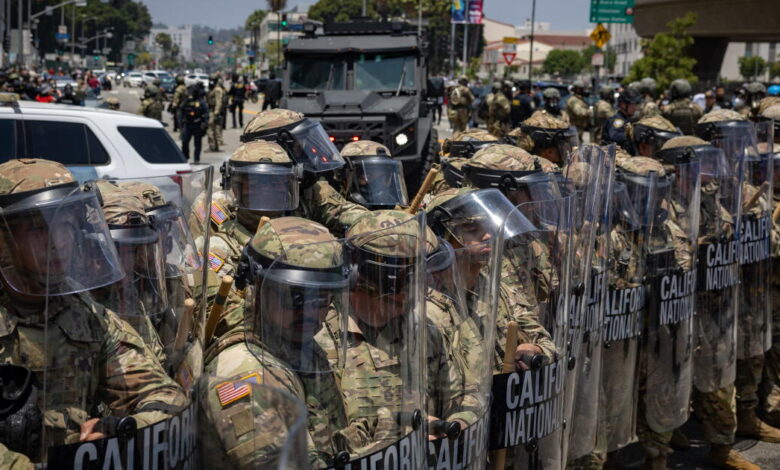
A federal appeals court ruled Friday that the previous administration illegally usurped California Governor Gavin Newsom’s command of the state’s National Guard by ordering a surge of troops into Los Angeles and across the state during protests against mass deportation programs.
The 2-1 decision by the 9th Circuit Court of Appeals split the court, with Judge Jennifer Sung, a Biden appointee from Portland, and Judge Eric D. Miller of Seattle forming the majority. Judge Mark J. Bennett of Honolulu dissented. Writing for the majority, Sung concluded that the deployment order exceeded presidential statutory authority and encroached upon the calling-forth power assigned to Congress, violating the constitutional separation of powers.
The ruling effectively forecloses what California Attorney General Rob Bonta described as an attempt by the administration to preserve its right to invoke an obscure and virtually untested subsection of federal law. Administration lawyers had relied on this statute to seize command of state forces without invoking the far stronger Insurrection Act.
The legal dispute originated last June when 4,000 National Guard soldiers were federalized in response to unrest in Los Angeles stemming from immigration enforcement operations. California subsequently filed a lawsuit. Although U.S. District Judge Charles R. Breyer initially blocked the deployment, Sung, Bennett, and Miller later stayed his order, establishing a standard of judicial review that granted immense deference to the executive branch and limited the judiciary’s ability to test the president’s rationale for deploying military forces domestically.
That initial ruling provided a legal mechanism for deploying soldiers against civilians in urban areas, a precedent later applied in Portland during the fall when another panel stayed an order by U.S. District Judge Karin Immergut to stand down troops. The Portland proceedings involved Department of Justice data that officials later admitted was false, prompting an extraordinary appeal from Judge Jay Bybee urging the court to reinterpret the statute and warning that federal control over domestic affairs poses a profound threat to state sovereignty.
The conflict ultimately reached the Supreme Court after a 7th Circuit panel determined the administration had provided insufficient evidence to justify a deployment even under the 9th Circuit’s lenient deference standard. On December 23, Supreme Court justices adopted an academic reading of the statute, ruling that it only permits the president to commandeer National Guard forces if a situation has outmatched the standing army. Federalized troops were subsequently ordered to leave Los Angeles that same month.
In Friday’s ruling, the 9th Circuit determined that the administration’s claim that Los Angeles was experiencing a rebellion last June did not reflect a colorable assessment within a range of honest judgment. Relying on the plain text of the statute and dictionary definitions, the majority found that officials failed to furnish evidence of a violent, armed, organized, open, and avowed uprising against the government as a whole, or anything comparable.
The court warned that accepting the Justice Department’s reliance on subsidiary definitions of rebellion would allow the executive branch to deploy military forces against nearly any form of resistance, including peaceful demonstrations. The majority emphasized that resistance lacking violent, armed, and organized characteristics directed at the government as a whole does not warrant a military response. Because the defendants failed to identify legal authority for the military to execute laws in California, the court concluded they could not establish that the president possessed the authority to federalize the state’s troops.