OpenAI has officially introduced its newest artificial intelligence model, GPT-6.1 Terra, positioning the system as a major leap forward in workplace automation, visual reasoning, and computer control. Company leadership highlighted the release as the opening of a new era for computer operations, noting that the model excels at managing day-to-day workplace duties ranging from drafting proposals and interpreting technical blueprints to filling out spreadsheets and editing video footage.
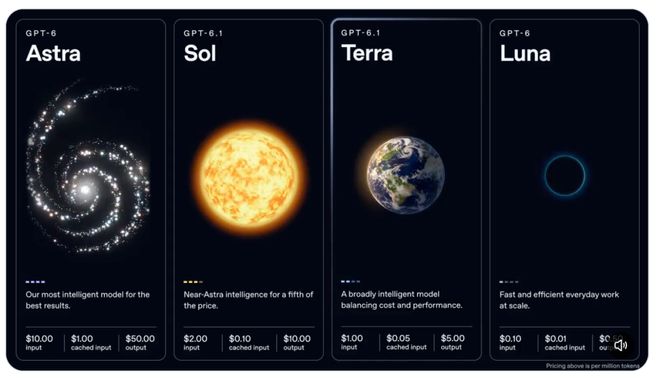
The newly released model aims to strike a balance between high-tier intelligent performance and operational costs, delivering speed, capability, and pricing combinations tailored for developers and enterprise users. Standard API pricing for GPT-6.1 Terra is set at $1 per million input tokens, $0.05 per million cached input tokens, and $5 per million output tokens. These rates represent a 50 percent price reduction compared to both GPT-5.6 Terra and GPT-6.1 Sol, allowing developers to automate large-scale tasks such as processing incoming invoices and entering structured data into accounting software at a fraction of previous expenses.
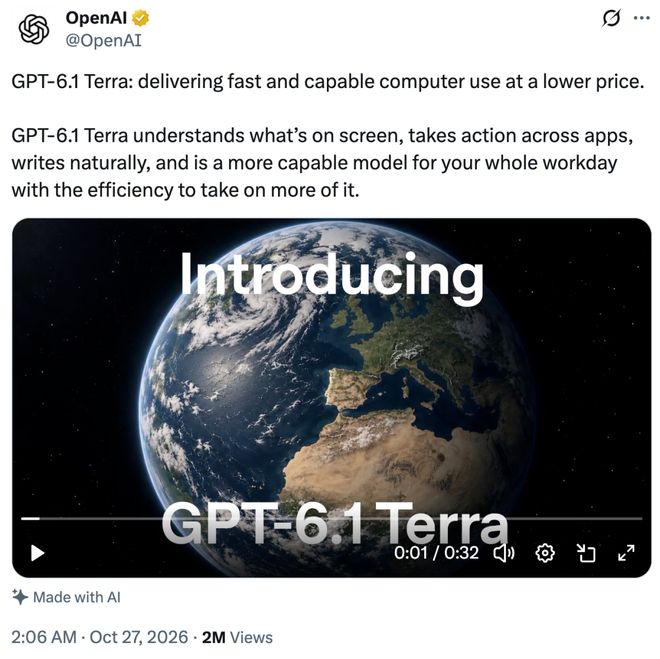
Availability begins immediately for users subscribed to Plus, Pro, Enterprise, and Edu tiers, who can access GPT-6.1 Terra within ChatGPT Work and Codex. Developers can also invoke the model directly through the OpenAI API using the identifier gpt-6.1-terra. Within ChatGPT Work and Codex environments, the model’s efficiency allows subscription quotas to stretch further, completing significantly more tasks per allocation than its predecessor, GPT-5.6 Terra, and exceeding the task volume achievable with GPT-6.1 Sol or GPT-6 Astra under identical constraints.
To evaluate the system’s desktop operation capabilities, OpenAI utilized the Agents’ Last Exam benchmark, which tests professional tasks including the generation of 3D models from architectural blueprints and frame-by-frame reviews of animated films to create time-coded records for restoration teams. Under medium reasoning intensity, GPT-6.1 Terra scored 15 percentage points higher than GPT-5.6 Terra while operating at roughly one-third of the cost. When compared against GPT-6 Astra, Terra achieved comparable performance despite costing approximately one-tenth per token. At maximum reasoning intensity, the model demonstrated token usage efficiency more than three times that of Claude Opus 5.5, with per-token pricing at one-quarter of the competitor, reducing total task execution costs to approximately one-ninth. Furthermore, execution speed surpassed that of GPT-6 Astra and GPT-6.1 Sol by a factor of three.

Visual reasoning evaluations on the MMMU-Pro benchmark showed that GPT-6.1 Terra outperformed GPT-5.6 Terra across all reasoning intensity settings, achieving scores approaching OpenAI’s flagship models, GPT-6 Astra and GPT-6.1 Sol, at substantially lower expenses. Additionally, testing via OSWorld 2.1, which measures an AI agent’s ability to navigate desktop applications through multi-step workflows, revealed that medium-intensity runs of GPT-6.1 Terra surpassed the best recorded scores of GPT-5.6 Terra with significantly reduced per-task expenditures.
OpenAI placed significant emphasis this cycle on reducing model hallucinations and factual inaccuracies. In an internal prompting benchmark designed to provoke errors, low-intensity runs of GPT-6.1 Terra reduced the error rate from 53.6 percent down to 16.7 percent compared to GPT-5.6 Terra, representing a drop of nearly 37 percentage points. At maximum reasoning intensity, error rates fell by another 18 points to 4.3 percent, bringing the system close to the accuracy levels demonstrated by GPT-6 Astra and GPT-6.1 Sol.
Software engineering capabilities also experienced marked improvements. The Terminal-Bench 4.0 benchmark, which measures a programming agent’s capacity to resolve command-line problems such as fixing layout shifts during page loads, showed that GPT-6.1 Terra resolved 50.3 percent of tasks at maximum reasoning intensity. This figure more than doubles the previously published 21.5 percent score achieved by GPT-5.6 Terra, though GPT-6.1 Sol and GPT-6 Astra remain preferable options for the most complex programming challenges. In scientific computing evaluations using Terminal-Bench-Science 0.1, which tests code-based execution of research assignments like tracking cell division in time-lapse footage, Terra outperformed GPT-6.1 Sol at lower costs, trailing Opus 5.5 by fewer than five percentage points while requiring less than one-fifth of the estimated cost.
Alongside efficiency and performance updates, OpenAI maintained rigorous security and alignment protocols. Under the organization’s preparedness framework, GPT-6.1 Terra reached a critical capability threshold in cybersecurity while retaining the safeguards originally developed for GPT-6 Astra. The model also inherits alignment enhancements from the GPT-6 series, demonstrating an increased propensity to restrict operations within user-defined boundaries and truthfully report capability limitations or operational obstacles. In prompt injection testing, the model exhibited strong resistance against malicious instructions designed to divert it from user-specified workflows.