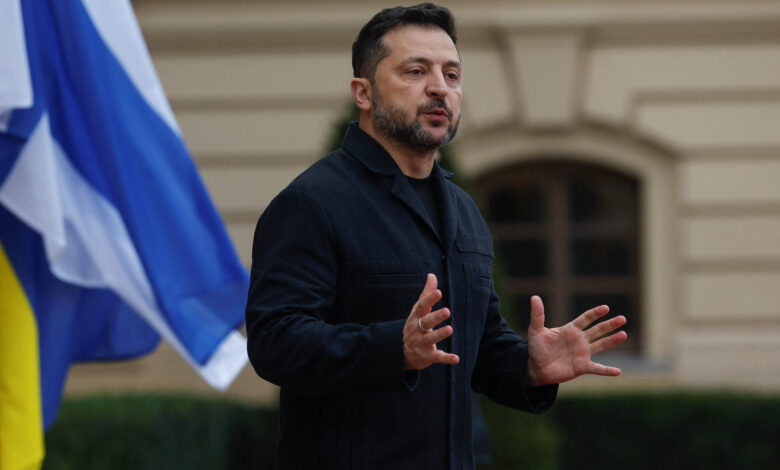
President Volodymyr Zelenskiy announced a series of successful Ukrainian military offensives on Tuesday, detailing unconventional tactics used to reclaim territory and strengthen Kyiv’s position in the 4-1/2-year-long war. Among the operations revealed was a specialized maneuver in the northeast where Ukrainian troops utilized existing gas pipeline infrastructure to outflank and neutralize Russian positions.
In his nightly address, Zelenskiy characterized the current battlefield situation as the strongest Kyiv has maintained in some time. He emphasized that these recent gains were driven by technology-driven planning, though he reiterated that continued success depends on Western allies providing additional air defense systems to protect advancing troops and newly regained settlements.
The most striking detail of the announcement involved “Operation Veles,” conducted near the city of Kupiansk in the Kharkiv region. Kupiansk, which Ukraine originally liberated in late 2022, has been under persistent Russian pressure for months. According to the President, Russian forces had attempted to use underground gas pipelines as a subterranean route to bypass Ukrainian defensive lines. However, Ukrainian commanders identified the move and turned the infrastructure against the occupiers.
Zelenskiy described the counter-move as an “extraordinary success,” noting that Ukrainian fighters utilized the same underground network to surprise and displace Russian units. He credited the operation’s success to its sophisticated planning and the ability of field commanders to adapt to unconventional battlefield conditions.
Further north, Zelenskiy detailed “Operation Vivaldi,” which targeted Russian infiltration groups threatening the strategic “fortress belt” of the Donbas region. This area includes the heavily fortified cities of Sloviansk and Kramatorsk, which remain primary targets for Moscow’s goal of seizing the entirety of eastern Ukraine. Reporting from senior commanders indicates that the Vivaldi offensive, led by Ukraine’s Third Army Corps, successfully cleared Russian infiltration groups from an area spanning 75 square kilometers (29 square miles). In addition to neutralizing these groups, Ukrainian forces reportedly recaptured 10 square kilometers of territory that had been under Russian control.
These recent maneuvers follow an earlier offensive in August, which Zelenskiy noted had resulted in the return of 26 villages to Ukrainian administration. He also referred to an ongoing air assault operation in eastern Ukraine, though specific details regarding its current objectives remain classified.
The Ukrainian reports stand in sharp contrast to the narrative provided by the Kremlin. Russian officials have maintained that their military is advancing across all sectors of the 1,200-kilometer (750-mile) front line. Valery Gerasimov, the chief of Russia’s General Staff, claimed earlier this month that Moscow’s forces had captured 92 Ukrainian settlements since the beginning of September, specifically naming the town of Dobropillia as a recent acquisition.
Ukraine’s military leadership has dismissed these Russian claims, asserting that Moscow is exaggerating territorial gains. Despite the reported Ukrainian successes, Russia has pledged to continue its campaign until the entire Donbas region is captured, rejecting calls for a short-term ceasefire in favor of a total resolution of the conflict on its own terms. As the war enters its 54th month, Zelenskiy signaled that while the initiative has shifted in several key sectors, the intensity of the fighting requires sustained air superiority to maintain the momentum of operations like Veles and Vivaldi.