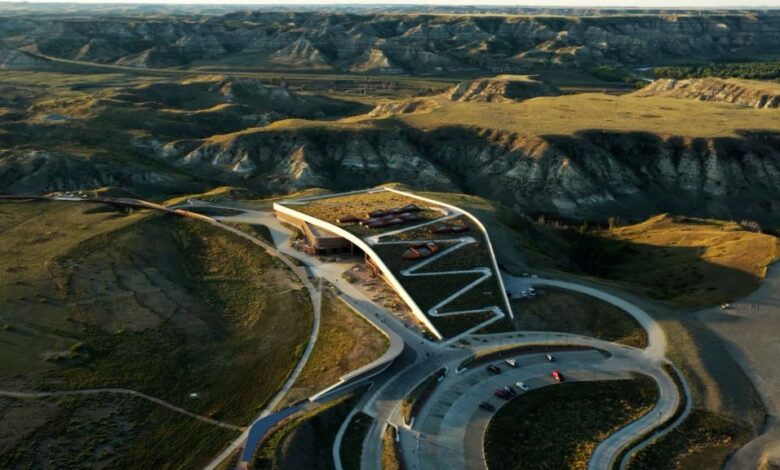
A striking architectural tribute to the nation’s 26th president has opened in the rugged Badlands of western North Dakota, drawing large crowds and offering visitors a deeply immersive look at a transformative figure in American history. The Theodore Roosevelt Presidential Library stands in a remote landscape that profoundly shaped the leader’s life and lifelong dedication to conservation.
Craig Dykers, co-founder of the international architecture firm Snøhetta, designed the expansive 93,000-square-foot facility. Seeking inspiration for the project, Dykers camped alone in the Badlands for 12 days. The resulting structure incorporates heavy timber, rammed earth walls, and regional materials, featuring a walkable roof and a low-lying silhouette designed to echo the surrounding terrain rather than intrude upon it.
The location holds deep personal significance for Theodore Roosevelt, who first traveled to the small town of Medora to hunt bison in 1883. He returned the following year as a heartbroken 25-year-old after losing both his wife and his mother on the same day to different causes in the same house. Edward O’Keefe, CEO of the Theodore Roosevelt Presidential Library Foundation, noted that the future president found resilience, healing, and recovery in the Dakota wilderness after writing in his diary that the light had gone out of his life.
The Theodore Roosevelt Presidential Library Foundation, a nonprofit organization, successfully raised more than $500 million to complete the ambitious project. Though operating as a presidential library in name only—as Roosevelt’s personal papers are largely housed elsewhere—the institution displays famous speeches along its walls alongside photographs and artifacts spanning his life. Exhibits feature items from his student days at Harvard, a hat and single-action Colt revolver from his tenure as a New York City police commissioner, his custom-tailored Rough Rider uniform from the Spanish-American War, and an interactive AI hologram of Roosevelt developed by Microsoft.
Since opening its doors on July 4, the library has welcomed large crowds eager to explore the life of a leader who left an indelible yet complicated mark on the nation. While celebrated as a champion of conservation and public lands, Roosevelt was equally known for advocating military might and expansion abroad. Educational exhibits within the facility address these more troubling aspects of his legacy, including his belief in social Darwinism, white racial superiority, and policies aimed at the forced assimilation and eradication of Native American cultures.
Candace Stock, the library’s head chef and a Native American who grew up on the White Earth Reservation in Minnesota, approaches these complex truths through culinary arts and cultural sharing. Acknowledging that the surrounding region is holy Native land, Stock emphasizes a path forward built on partnership and connection to the landscape.
The influx of visitors has provided an economic boost to the surrounding region, which was already deeply tied to Roosevelt’s legacy through tourism and local productions such as the Medora Musical. Local performers and business operators report nightly crowds exceeding one thousand people, driven largely by the opening of the new cultural landmark.
Roosevelt famously wrote in a 1918 letter that if he could keep one memory of his entire life, it would be his experiences as a rancher and cowboy in Dakota. With the opening of the new library, that connection to the Badlands remains central to how his complex legacy is preserved and examined.