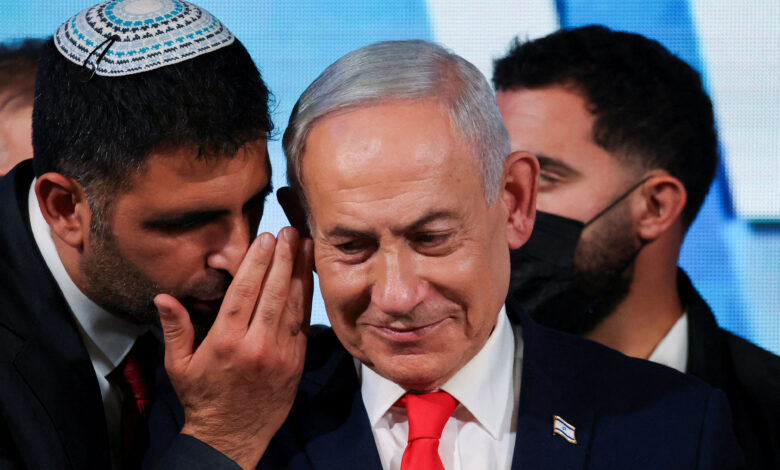
Prime Minister Benjamin Netanyahu and opposition challenger Gadi Eisenkot offered competing claims for leadership on Tuesday following Israel’s national election, with Netanyahu pushing for a right-wing coalition while Eisenkot argued that voters had rejected the longtime leader. Neither candidate claimed outright victory as exit polls left major political blocs deadlocked in the 120-seat Knesset.
Voting turnout reached 77.7%, according to Israel’s Central Elections Committee, marking the highest participation rate in more than two decades and representing an increase of roughly seven percentage points compared to the 2022 election. Despite the high turnout, early projections failed to break the legislative impasse.
Exit polls from Kan 11 and Channel 13 showed rival political blocs tied at 51 seats each, while Channel 12 projected a narrow 52-49 edge for Netanyahu’s Likud-led bloc. None of the projections approached the 61 seats required for a parliamentary majority. The ongoing legislative deadlock could keep Netanyahu in office as a caretaker prime minister through prolonged coalition negotiations or potentially until a new election is called.
Far-right religious parties led by Itamar Ben-Gvir and Bezalel Smotrich were projected to secure a combined 13 seats within Netanyahu’s alliance, registering no major gains. Meanwhile, Arab parties positioned outside the two primary blocs could emerge as potential kingmakers, though Eisenkot, leader of the Yashar party and a former military chief, has nearly ruled out forming a government with them, narrowing his prospective paths to a majority.
Addressing party supporters at Likud’s election headquarters in Jerusalem shortly after 3 a.m., Netanyahu called for the creation of a strong nationalist government and emphasized Israel’s recent military actions. He also raised the prospect of renewed joint operations alongside U.S. President Donald Trump to counter Iran.
“Israel faces a singular historical opportunity, together with our partner President Trump, to remove the existential threat of Iran once and for all,” Netanyahu told supporters. “But ulterior motives must not divert us from this sacred mission.”
Earlier in the evening, Eisenkot cautioned against using national security for political ends, declaring that Netanyahu lacked a popular mandate. “Netanyahu is a caretaker prime minister, without a mandate or the people’s trust,” Eisenkot said, calling on the security establishment to resist any prioritization of political interests over national defense.
Eisenkot, 66, emerged as Netanyahu’s most formidable challenger after losing a son and two nephews in the ongoing Gaza conflict. Having entered politics four years ago, he joined Netanyahu’s war cabinet following the October 2023 Hamas attacks before resigning eight months later over leadership disputes. While Eisenkot offers a departure from Netanyahu and his far-right allies, he maintains a hawkish security stance, opposing Palestinian statehood and supporting the dismantlement of Hamas’s military wing.
At the headquarters of the Joint List, an alliance of Arab parties, supporters celebrated high voter turnout among Palestinian citizens of Israel. Candidates hoped the strong turnout would block Netanyahu’s return to power. Yohanan Plesner, president of the Israel Democracy Institute, noted that while the exit polls represented a significant setback for Netanyahu’s coalition, Eisenkot had not secured a clear path to victory as official votes continued to be counted.
Final election results are anticipated by Thursday or Friday. If neither major bloc succeeds in assembling a governing coalition, Israel could face another round of voting, a prospect opposed by Eisenkot given the heavy voter participation.