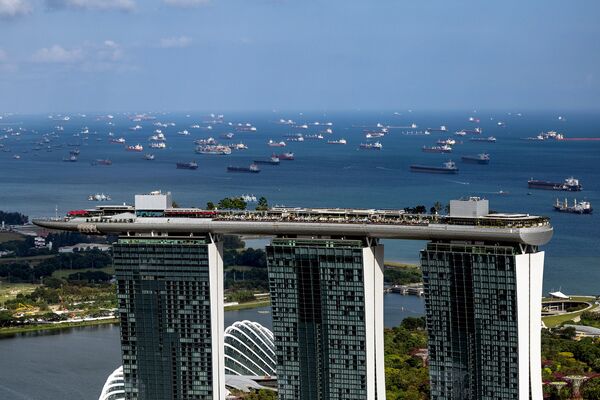
From the observation deck of Singapore’s Marina Bay Sands hotel, the city-state’s historic promise and contemporary vulnerabilities exist in plain view. In the foreground, commercial vessels anchor in dense formation, testifying to a decades-long economic model built on servicing the massive trade volume funneling through the narrow local strait. Across the water, the coast of Indonesia—boasting nearly 50 times the population and 2,500 times the land area of Singapore—serves as a constant reminder that the island republic’s prosperity remains tied to amicable relations with much larger neighbors.
Those regional sensitivities have flared into public view amid a recurring environmental and diplomatic test. For weeks, agricultural fires on the Indonesian islands of Borneo and Sumatra have blanketed Singapore in a thick haze. Although Singapore enacted anti-haze legislation a decade ago to combat the public health hazard, enforcement has collided with regional friction. Just days after Singapore announced regulatory measures against 10 Indonesian companies linked to the blazes, Jakarta initiated cuts to natural gas pipeline supplies destined for Singapore.
While officials in Jakarta suggested the gas supply reduction could stem from routine shifts, timing and rhetoric have fueled concern. Singapore has progressively moved toward liquefied natural gas and away from piped regional energy, anticipating that neighboring economies would eventually require more of their own resources. A crucial pipeline infrastructure project enabling Indonesia to redirect gas domestically was completed recently, and the affected shipments currently account for less than two percent of Singapore’s daily demand. However, recent remarks from Indonesia’s energy distribution minister warned neighboring nations to exercise caution regarding actions that might displease Jakarta if they wish to avoid export cutoffs.
This friction underscores deep-seated anxieties over resource security that date back to Singapore’s founding era. Established as a British free port in the nineteenth century to circumvent Dutch commercial control, the city-state subsequently built its post-independence economy around oil refining, container shipping, and long-haul aviation. Political separation from Malaysia in 1965 immediately triggered fears regarding water supplies, prompting a massive engineering effort in desalination, recycling, and reservoir construction that achieved near self-sufficiency.
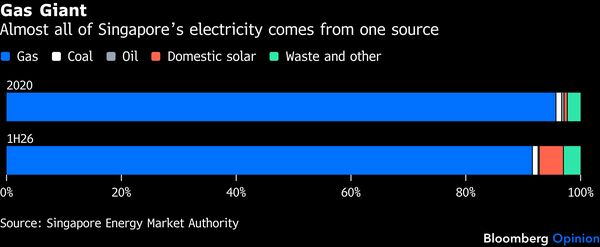
Energy remains a stark exception. Even liquefied natural gas shipments could be severed by hostile naval actions or blockades. Proposals to introduce nuclear power have repeatedly stalled due to geographic constraints; the mandatory 20-kilometer evacuation zone established after Japan’s Fukushima Daiichi disaster is larger than Singapore’s entire territory. Meanwhile, a government initiative to install four gigawatts of solar panels by 2035 would cover roughly five percent of the country under glass and silicon while supplying barely a tenth of total electricity demand.
To diversify its power network, Singapore is pursuing cross-border renewable energy projects and transmission lines connecting to Vietnam, Laos, Cambodia, Malaysia, Indonesia, and Australia. Yet these vital energy corridors remain vulnerable to political disruption. Singapore’s leadership in shaping a regional power grid across the Association of Southeast Asian Nations is designed to diffuse risk through mutual interdependence rather than absolute self-reliance.
Historically, small maritime republics such as Venice thrived for centuries as commercial nodes during eras of open global trade. Yet when European politics shifted toward nationalism and mass armies, Venice’s vast wealth failed to protect it from continental powers, culminating in its annexation by Napoleon in 1797.
Analysts note parallels in today’s international environment, where major powers increasingly weaponize trade flows, computer chips, critical minerals, and intellectual property to exert leverage over rivals. Founding father Lee Kuan Yew highlighted this existential dependency in a 2007 interview, observing that without international law and order, a small state subjected to a siege or control of sea lanes would face starvation. As protectionist barriers rise across global commerce, Singapore’s modern leadership faces the challenge of navigating an increasingly hostile geopolitical climate.