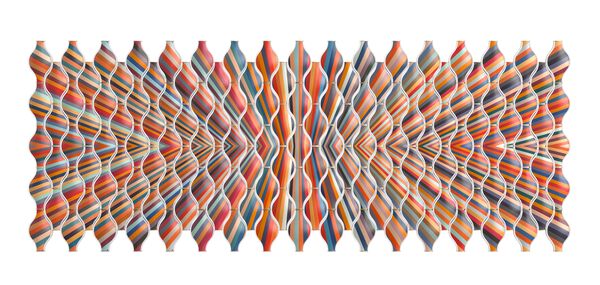
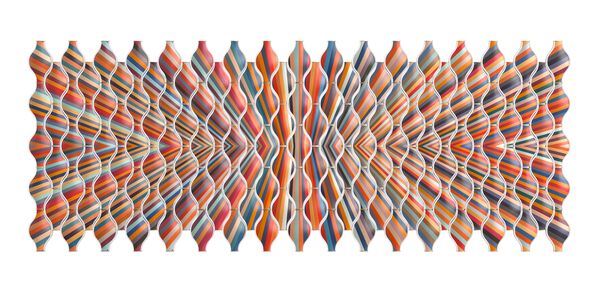
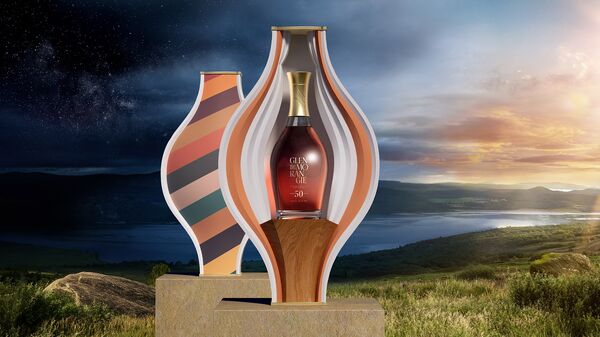
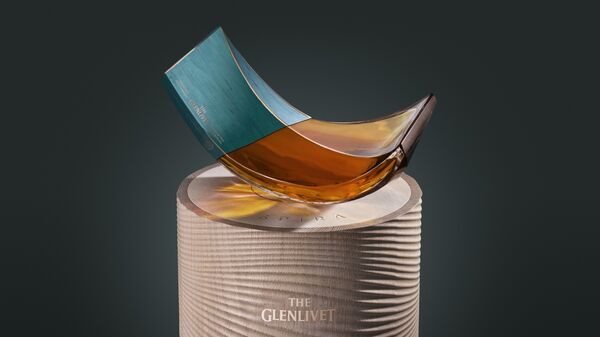
When ceramicist Peter Pincus walked into his studio in Rochester, New York, in November 2024, hugged his wife and business partner, Laurie, and burst into tears, he asked a simple question born of exhaustion: “What did I do to our family?” The project that brought him to the brink of a nervous breakdown involved more than 25 failed prototype attempts before the technical hurdles were cleared to produce a vessel worthy of its transatlantic destination in Scotland. Over three years, a production crew of 15—including specialized scientists who engineered firing techniques for large ceramics with complex three-dimensional curves on both sides—labored to create what was essentially an unfolded barrel incorporating an abstracted version of Fingal’s Cave on Staffa Island in the Hebrides.
The fruit of that intense labor was a bespoke housing for Glenmorangie 50 Years Old, a Highlands distillery release priced at €30,000, or roughly $36,000. It is part of a sweeping industry trend that has seen luxury whisky distilleries commission extravagant, custom boxes and cases for their oldest expressions. Because each unique container can easily cost thousands of dollars to produce, total packaging budgets for limited-edition runs often surpass $1 million when brands commission 149 boxes or more.
While purists and traditionalists frequently dismiss such ornamentation as superficial extravagance, distillers are finding that presentation plays a critical role in market success. The category of very old Scotch whiskies—those aged in barrels for half a century or more—has expanded significantly over the past 15 years, with secondary marketplaces offering more than 100 options across 50-, 55-, and 60-year age expressions. For Glenmorangie, which had never released a bottling of this age before the fall launch, the goal was not immediate profit.
Caspar MacRae, chief executive officer of Glenmorangie, notes that the bottling is not a major profit driver once accounting for the vast investment of time, effort, and resources required. Instead, the objective is to generate broader brand awareness and desire. Describing the offering as a once-in-a-lifetime experience, MacRae emphasizes that the surrounding packaging is an essential component of that experience.
Auction results appear to validate that strategy. Jonny Fowle, global head of whisky at Sotheby’s, observes that pairing an exceptional liquid with extraordinary packaging creates an item far greater than the sum of its parts. Historically, price points for 50-year-old expressions were driven primarily by pure rarity. However, as such bottles have become more common, producers have spent the past seven years using innovative packaging to distinguish their offerings in a crowded market.
This dynamic has triggered the whisky equivalent of a biological arms race. The Macallan initiated the trend in 1986 by positioning its 60-year-old 1926 bottling as an ultra-premium experience priced at £5,000, with elaborate packaging arriving in the early 2000s. Other distilleries quickly followed suit out of concern they would be left behind, according to London-based packaging designer Alexis Burgess.
Biologists study how features like the peacock’s unwieldy tail feathers serve a signaling function, demonstrating genetic vigor beyond mere visual attraction. High-end Scotch bottles operate on a similar principle, with distilleries willing to invest years and substantial funds into packaging to signal that the liquid inside is extraordinarily special. This visual reassurance aims to convince purchasers that they are receiving full value for their investment.
Unlike cognacs such as Rémy Martin’s Louis XIII—which relies on Baccarat to produce roughly 15,000 standardized decanters annually to maintain consistent branding dating back to 1874—Scotch distillers face the challenge of massive product lineups where one bottle may cost thousands of times more than an entry-level blend. High-end Scotch therefore emphasizes uniqueness over consistency. As MacRae points out, even if a distillery held a second cask of 50-year-old whisky, its flavor profile would differ, making distinct presentation essential for collectors seeking both.
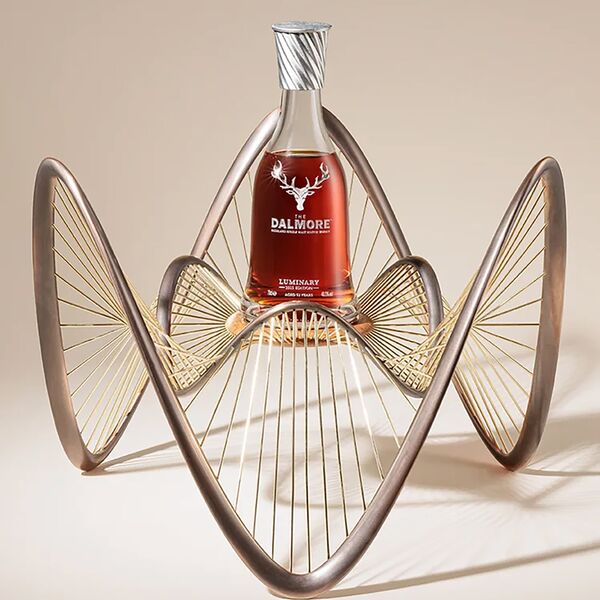
While collectors ostensibly pay for the liquid, industry experts note that minimalist packaging has repeatedly failed at these price points. Buyers spending tens of thousands of dollars on display pieces expect high aesthetic value. Glasgow-based designer John Galvin notes that his packaging pieces frequently end up in New York penthouses, superyachts, or stately homes, where they function as high-end decoration and broaden the buyer pool to include fine art collectors.
These connoisseurs may not place a standalone financial value on an empty box, but once the whisky is consumed, the vessel often remains in place to house a different liquid or serve as a permanent art piece. Laurie Pincus summarizes the appeal succinctly: it represents a piece of fine art designed to hold another piece of fine art.