In an era where the high-concept romance often finds itself relegated to streaming platforms, directors Alex Huston Fischer and Eleanor Wilson are making a notable return to the theatrical format with “Wicker.” The film, a tender and frequently erotic exploration of human connection, marks a rare entry into the “romantasy” subgenre that prioritize heart and vulnerability over mere spectacle. Based on the unpublished short story “The Wicker Husband” by Ursula Wills, the production centers on a lonely protagonist navigating the rigid matrimonial expectations of a provincial town.
Olivia Colman stars as the Fisherwoman, an independent but isolated angler who earns her living selling catches at a local market. Surrounded by a village that increasingly prioritizes marriage and conventional domesticity, she finds herself the target of social derision, with townsfolk frequently labeling her a “spinster.” In a move that begins as a defiant joke against these traditions, she approaches the local Basket Weaver, played by Peter Dinklage, with a unique commission: she asks him to weave her a husband. While her initial intent is to mock the judgmental villagers, there remains a buried longing for a companion who offers more than the scales and fins of her daily trade.
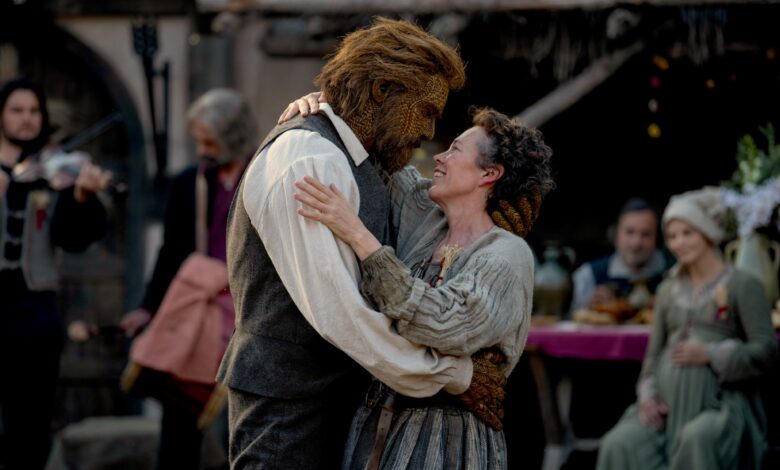
The narrative takes a supernatural turn when the Basket Weaver delivers his creation a month later. The Wicker Husband, portrayed by Alexander Skarsgård, is a towering figure of organic material, complete with sinewy muscles and a seductive frame made entirely of woven wicker. In a development that surprises both the Fisherwoman and the townspeople, the creation is alive. Rather than sparking immediate terror, his presence primarily generates curiosity, particularly as he displays a natural and undemanding kindness that stands in stark contrast to the strained, often loveless marriages that define the quaint village.
As the bond between the Fisherwoman and her supernatural spouse strengthens, the film leans into the unabashed eroticism often found in supermarket romance novels. Fischer and Wilson embrace this “Harlequin” influence, using it to highlight the sexual desire of an older woman. The directors move past the logistical questions of such an arrangement—how it works or if the material might break—to focus on the emotional and physical gratification of a relationship built on genuine appreciation. The technical execution of the Wicker Husband relies on detailed makeup and practical effects to create a design that is simultaneously disconcerting and alluring, allowing the story to remain grounded in its central romance.
However, the blossoming relationship does not exist in a vacuum. The harmony of the new couple triggers a wave of envy among the villagers, most notably the Tailor’s Wife, played by Elizabeth Debicki. As a longtime acquaintance of the Fisherwoman, the Tailor’s Wife represents the frustration of many in the town who find themselves in stable but unfulfilling unions. This jealousy serves as the primary tension of the film, illustrating how true tenderness can inadvertently breed malice in those who feel they have missed out on such a connection. The Fisherwoman eventually finds herself grappling with the fragility of her happiness, noting that “it’s easier to believe the bad than the good” when faced with external judgment and her own internal fears.
Skarsgård’s performance is particularly noteworthy for its restraint. Delivering relatively few lines in a soft-spoken manner, he manages to convey a deep, human sensitivity that transcends the ornate practical effects of his character’s design. This role follows his recent work in “Pillion,” continuing a trend of the actor choosing daring projects that investigate the more complicated and unusual facets of love. His chemistry with Colman serves as the film’s anchor, proving that even with a fantastical conceit, the most affecting moments arise from sincere interaction and the shared vulnerability of two people finding their rhythm.
Ultimately, “Wicker” functions as a meditation on the innate tragedy of love and the fear of loss. It mirrors the emotional core of classic romances, such as “The Age of Adaline,” where the fantastical elements serve as a lens through which to view the human heart. By focusing on the beauty of growing old together—and the heartbreak inherent in the absence of that shared journey—the film transcends its initial “wicker” gimmick. It leaves the audience with a story where love and sex are woven into a sturdy, life-defining bond, suggesting that fantasy can mirror reality as long as the connection remains honest.