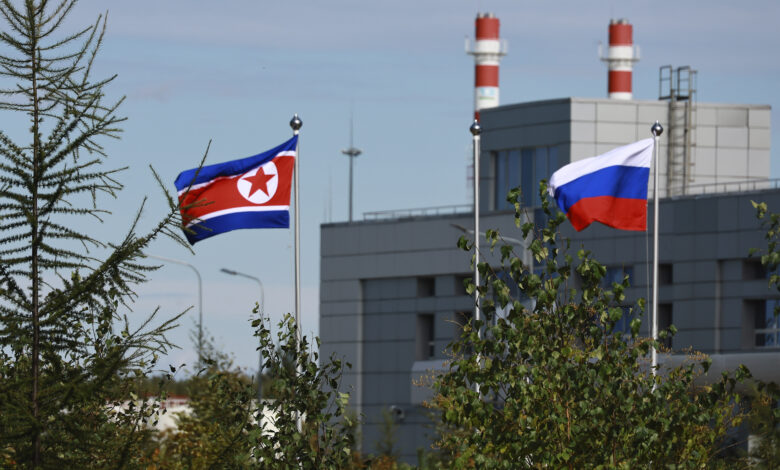
North Korean workers are being funneled into forced labor across Russia through a sophisticated broker network that utilizes fraudulent student enrollments to bypass international sanctions and domestic labor laws, according to an investigation released on Thursday. The months-long inquiry, conducted by the Netherlands-based nonprofit law foundation Global Rights Compliance, details how the scheme operates as a state-sponsored work program that helps fund Pyongyang’s ballistic missile development while simultaneously supporting Moscow’s military-industrial complex.
The trafficking network is spearheaded by Russian businessman Vladimir Sokolov through the labor-brokering platform KNDR.su. The platform markets North Korean laborers to prospective Russian employers operating in sectors such as agriculture, construction, industry, and information technology. According to the findings, the platform charges a placement commission ranging between 100,000 and 150,000 roubles, equivalent to approximately $1,240 to $1,860, for each worker supplied.
Investigators from Global Rights Compliance posed as prospective employers to gather evidence, engaging in direct conversations with Ruslan Zhukov, operations director for Sokolov’s enterprise. During these interactions, Zhukov explained that North Korean nationals are formally enrolled in colleges they never actually attend. This maneuver is executed specifically to evade the application of standard labor laws. Zhukov further detailed the grueling conditions imposed on the workers, noting they are required to toil for 12 hours a day, six days a week.
The operation directly defies international restrictions. Under a 2017 United Nations Security Council resolution, member states are strictly prohibited from hosting North Korean workers, a measure designed to cut off revenue streams used to finance Pyongyang’s nuclear weapons and missile programs. Despite these mandates, monitoring data from an 11-country sanctions enforcement team indicates that between 35,600 and 101,280 North Korean workers operated overseas in 2025, generating an estimated $450 million to $800 million for the North Korean government. Official immigration data shows Russia issued more than 36,000 visas to North Koreans in 2025—representing a fourfold increase from the prior year—with almost all officially classified for educational purposes.

Beyond funding Pyongyang’s military ambitions, the Global Rights Compliance report indicates that the brokering network directly assists Russia’s war effort in Ukraine. Investigators documented instances where Sokolov publicized at least two work sites connected to Moscow’s military-industrial complex.
Representatives for the network declined to address the findings directly through standard channels. Requests for comment sent to Sokolov’s holding company, Black Horse, and KNDR.su went unanswered prior to publication. However, Global Rights Compliance noted that Zhukov previously issued a statement denying the report’s allegations entirely, characterizing the claims as false and fabricated. According to Zhukov’s statement, the arrangement involves exclusively students from a specialized college dispatched to Russia under an intergovernmental agreement focused on experience exchange and practical educational and industrial training.
Lara Strangways, head of business and human rights at Global Rights Compliance, emphasized that the broker network underscores the expanding partnership between Moscow and Pyongyang. The arrangement benefits both governments simultaneously by supplying labor to Russian industry, including facilities tied to the conflict in Ukraine, while channeling wages back to support North Korea’s military apparatus. Strangways stressed that international actors must recognize the role forced labor plays in sustaining this cross-border alliance if they intend to mount an effective policy response.
Relations between North Korea and Russia have intensified significantly in recent years as Moscow faced deepening international isolation following its full-scale invasion of Ukraine in 2022. The historical allies ratified a comprehensive mutual defense treaty in 2024, which subsequently saw Pyongyang dispatch thousands of troops to fight alongside Russian forces on the front lines in Ukraine.