To cast his ballot in Israel’s pivotal parliamentary elections on Tuesday, Shai Schoenfeld had to embark on a journey that few voters in the world would consider. A 20-something Israeli living abroad, Schoenfeld’s commute to the polls was a 10,000-mile, 30-plus-hour odyssey that began at a remote sheep station in the Australian outback and ended in his village in the Galilee, in northern Israel.
Schoenfeld is part of a massive, spontaneous migration of tens of thousands of Israelis returning home from across the globe to participate in a contest widely regarded as the most critical in the nation’s history. From the ranch near Tarcoola in southern Australia where he had been working, Schoenfeld drove eight hours to Adelaide for a short flight to Sydney. From there, he boarded a 14.5-hour flight to Abu Dhabi, followed by a three-hour flight to Tel Aviv and a final two-hour drive to his home in Kfar Hananya.
“I’m doing this 99% out of fear,” Schoenfeld said of his second national election. He described the current political and social climate as one of failure on multiple fronts, citing international pressure and the suffering of people on both sides of the regional conflicts. To him, the effort is worth the cost because the outcome will determine whether the country shifts toward a new direction or remains on its current path.
The Tuesday contest is a high-stakes race pitting long-serving Prime Minister Benjamin Netanyahu and his religious and ultranationalist allies against a coalition led by former military chief of staff Gadi Eisenkot. The vote is functioning as a referendum on Netanyahu’s fitness to lead following the October 7 attacks and the subsequent wars involving Gaza, Lebanon, and Iran.
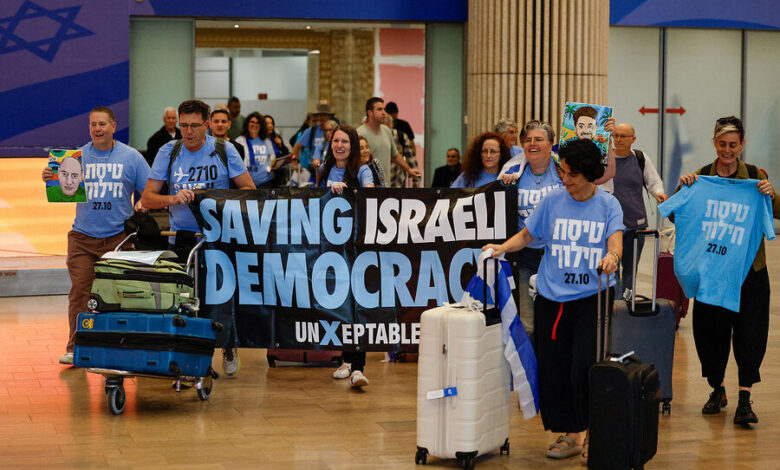
Because Israel does not permit absentee voting for regular citizens living abroad, the only way for the diaspora to influence the outcome is to return physically. The AID Coalition, a U.S.-based organization that advocates for overseas voting, estimated that approximately 67,000 Israelis have booked flights to participate in the election. For many, the cost and logistical hurdles of the trip are secondary to the perceived threat to Israel’s democratic future.
In New York, an Israeli citizen named Ron decided to fly back to vote for the first time since 2003. He was motivated by the Netanyahu government’s attempts to overhaul the judiciary, a move that sparked massive protests across Israel prior to the October 7 attacks. Ron, who requested that his last name be withheld due to his business ties in the Muslim world, said he felt compelled to return to prevent Israel from becoming a “pariah state.”

This sentiment was echoed at San Francisco International Airport, where Offir Gutelzon joined dozens of other tech industry employees for a 15-hour flight to Tel Aviv. Many in the group wore matching T-shirts with the slogan “Flight for Change.” Gutelzon, a co-founder of the pro-democracy group UnXeptable, compared the influx of returning voters to the waves of reservists who flew back to join their military units during the 1973 Mideast war or immediately after the 2023 attacks. He noted, however, that the scale of citizens returning specifically to vote is unprecedented.
“I find myself a representative on behalf of all Jewish people since I have the privilege to vote,” Gutelzon said, adding that his goal is to ensure Israel remains “Jewish and democratic” rather than sliding toward what he described as a “messianic theocracy.”
The final polls released prior to the election suggested a deeply polarized electorate with neither major bloc—Netanyahu’s nor Eisenkot’s—holding a clear path to an outright majority. With very few swing voters left in the country, the result is expected to hinge almost entirely on voter turnout. This reality has turned every individual vote, including those from citizens living half a world away, into a potentially decisive factor.
At Fiumicino Airport in Rome, travelers Daniel and Ariela Icekson waited for their connection to Tel Aviv, having departed their home near Boston. For them, the election represents a final opportunity to change the leadership of the country. Daniel Icekson described the Tuesday vote as the “last chance” to move past the Netanyahu era, framing the journey as a duty to the state’s future.
As the polls open, the sheer volume of returning citizens highlights the intensity of the political divide. Whether they are traveling from the Australian outback, the technology hubs of California, or the suburbs of New England, these voters are arriving with the shared belief that their physical presence at the ballot box is the only way to safeguard the nation’s trajectory.