The deep-sea floor, long the silent domain of marine life and tectonic shifts, has been formally designated a modern “battlefield” by regional defense leaders. At a recent security gathering in Singapore, Australian Defence Minister Richard Marles underscored a reality already understood by military brass and geopolitical analysts: the battle for technological supremacy between the United States and China has moved to the seabed. This competition centers on the security of undersea cables—the literal veins of the global economy—which carry more than 95% of international data flows and trillions of dollars in daily financial transactions.
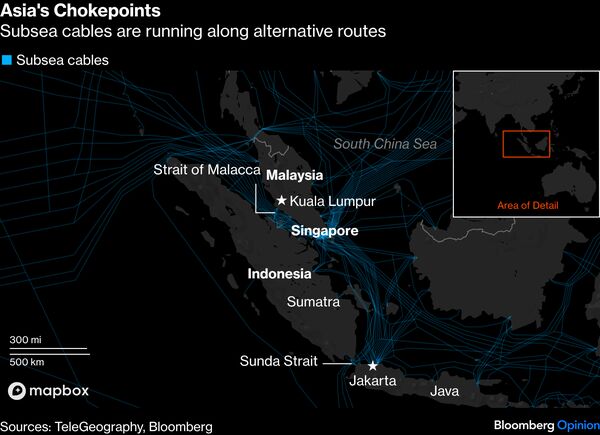
This shift in focus is driving a massive redesign of the Indo-Pacific’s digital architecture. For decades, the Strait of Malacca and the South China Sea served as the primary corridors for the subsea fiber-optic links connecting Asia to the rest of the world. However, these waters are increasingly viewed as strategic liabilities. The Strait of Malacca, which handles roughly 21% of global maritime trade by value, is now seen as a dangerous chokepoint. In response, major tech companies are beginning to bypass it entirely.
Google’s TalayLink project, for example, is set to connect Australia and Thailand via the Indian Ocean, utilizing a route west of the Sunda Strait to avoid the congestion of the Malacca corridor. Similarly, the Echo cable—a joint effort between Google and Meta Platforms Inc.—links the United States to Singapore via Guam and Indonesia. These multi-million-dollar investments are being rerouted into more difficult terrain specifically to reduce exposure to Chinese maritime presence and the regulatory control Beijing exerts over traditional routes.
In the South China Sea, the geopolitical contest is most visible. Beijing has begun utilizing its maritime enforcement and regulatory powers to dictate who can build and repair infrastructure. Analysts note that China is effectively redrawing the undersea map by imposing onerous permitting requirements that can stall or block non-Chinese fiber projects. There are also reports of the Chinese Coast Guard being used to harass repair crews or prevent them from accessing vital cable grounds. These pressures have forced projects like the $700 million Asia Connect Cable System to skirt the South China Sea entirely, choosing instead to run through the territorial waters of Indonesia and the Philippines.
In response to these threats, the U.S. and its partners are accelerating their own defense initiatives. A trilateral project involving Australia, the United Kingdom, and the United States (AUKUS) is currently developing underwater drone technology aimed at protecting subsea cables by 2027. Meanwhile, Singapore has launched a 17-country framework involving nations from Oceania, Europe, and the Middle East to coordinate the protection of critical maritime infrastructure.
The competition also extends to the hardware itself. Washington has engaged in a years-long effort to convince nations in Southeast Asia and the Pacific to shun Chinese vendors in favor of American, Japanese, or European alternatives. This pressure led to the 2019 restructuring of Huawei Marine Networks, which was sold to Hengtong Optic-Electric and rebranded as HMN Technologies Co. Despite the change in ownership, Western allies like Japan and Australia continue to push for the exclusion of such vendors from regional networks, citing risks of intelligence gathering or sabotage.
While the West has seen recent successes—such as the recent milestone where every Pacific Islands Forum member was connected to the global cable network—new risks are emerging on land. Experts warn that countries financing these cables must also address local data storage and processing. If Chinese suppliers fill the gap in building local data centers, the security of the undersea cables themselves may be compromised.
As the Quad leaders and ASEAN representatives prepare to meet in Manila next month, the security of these subsea networks is expected to be a priority. The outcome of these diplomatic and technical races will determine the flow of global information for decades to come, potentially isolating some nations while cementing the dominance of others in the deep-sea domain.
Get the latest World news
Subscribe to receive the latest stories from World.