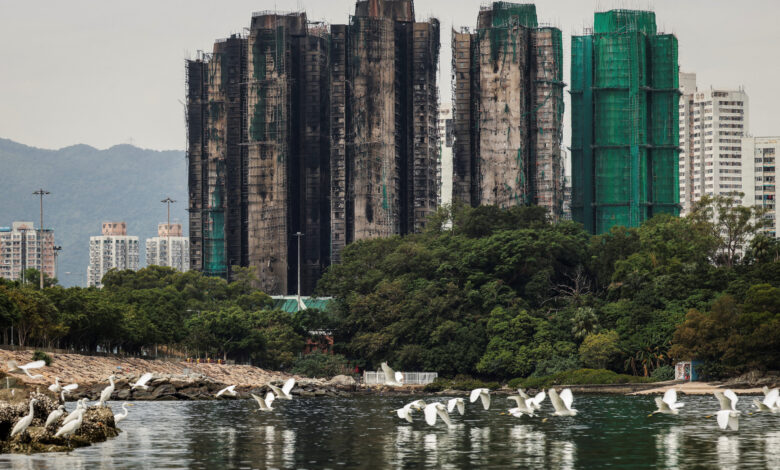
An independent inquiry in Hong Kong has placed direct blame on a renovation contractor, a project consultant, and four government departments for a catastrophic residential fire that claimed 168 lives last November. The findings were made public on Thursday in a comprehensive report spanning more than 1,000 pages by a judge-led panel.
The disaster struck the Wang Fuk Court housing complex in Tai Po, Hong Kong, where a massive blaze swept through the residential blocks. According to the committee’s findings, the fire was most likely ignited by a glowing source, such as a discarded cigarette.
The panel’s investigation uncovered widespread shortcomings by the primary firms hired for the renovation project. Prestige Construction & Engineering Co. Ltd., serving as the main contractor, and Will Power Architects Co., acting as the project consultant, were found to have been fully aware of severe fire risks while ignoring persistent complaints from residents. Investigators determined that Prestige failed to maintain proper oversight, cut corners, and neglected to enforce anti-smoking policies effectively on the site. Furthermore, the contractor rejected requests from the management committee to conduct the renovation in phases, instead enclosing all eight blocks simultaneously in combustible scaffolding and materials that accelerated the spread of the flames.

Will Power was cited for failing to provide independent supervision and neglecting to intervene in critical safety matters. The consultant reportedly approved the use of flammable foam boards and non-fire-retardant scaffolding nets despite recognizing the associated fire hazards and initially expressing concern. The panel concluded that Will Power enabled and acquiesced to cost-cutting and unsafe practices rather than acting as an independent check.
Beyond the private firms, the report identified systemic regulatory and supervisory failures across four government departments. The committee concluded that no single agency took effective ownership of fire safety issues, causing resident complaints regarding hazards, smoking, and procedural irregularities to fall into a regulatory vacuum. The Labour Department faced criticism for its handling of complaints concerning unsafe site practices and the fire retardancy of building materials. Additionally, the Independent Checking Unit (ICU) was cited for systemic regulatory failures and operational lapses that contributed to the dangerous conditions.
The inquiry highlighted a broader failure in the regulation and verification of temporary building materials, noting that authorities relied heavily on paper certificates without conducting laboratory testing or on-site sampling. A lack of communication and coordination among government bodies further exacerbated the crisis, allowing safety concerns to be bounced between departments without resolution.
The panel’s findings extended into systemic corruption within the building maintenance sector, acknowledging unlawful practices including widespread bid-rigging. Citing findings from the Competition Commission and the Independent Commission Against Corruption, the report noted that syndicates—some with triad affiliations—orchestrate tenders through cover bidding, bid suppression, and bid rotation. The committee declared that such a corrupt ecosystem is intolerable.