In an era defined by the infinite scroll and the relentless monetization of focus, a Dutch art institution is branding its resistance with a simple, provocative slogan: “Offline is punk.” The phrase, printed on buttons to mark the opening of a new museum bookshop, serves as a manifesto for a growing movement within the cultural sector that seeks to reclaim human attention from the digital world.
At Museum Voorlinden in Wassenaar, located in the densely populated corridor between The Hague and Amsterdam, the strategy is not just about showing art, but about deliberately engineering a counterpoint to the fast-paced nature of modern life. It is an approach that acknowledges the museum’s role in an economy designed to interrupt, where online behavior increasingly dictates offline experiences.
The challenge for modern cultural institutions is rooted in data. While the exact figures fluctuate, studies suggest the average museum visitor spends between 15 and 30 seconds in front of any single work of art. In the age of social media, this relatively short window can feel long compared to the millisecond swipes of a smartphone, yet it represents a superficial engagement that museums are now trying to deepen. The goal is to move beyond merely capturing attention to actively cultivating it.
Capturing attention is the immediate hook—the photogenic installation or the dramatic entrance designed for a camera lens. Cultivating attention, by contrast, is a slower process. It requires a visitor to remain with an unfamiliar thought or a complex emotion. According to the philosophy at Voorlinden, this sustained looking is only possible if the museum itself provides a sanctuary from the visual noise of the outside world.

This atmospheric engineering begins before a visitor even enters the building. The museum sits on a green estate that serves as an oasis in one of the busiest parts of the Netherlands. Regardless of how visitors arrive at the estate, the final leg of the journey must be completed on foot. This mandatory walk is designed to force a physical slowing down, encouraging guests to leave the attention-seeking digital world behind before crossing the threshold.
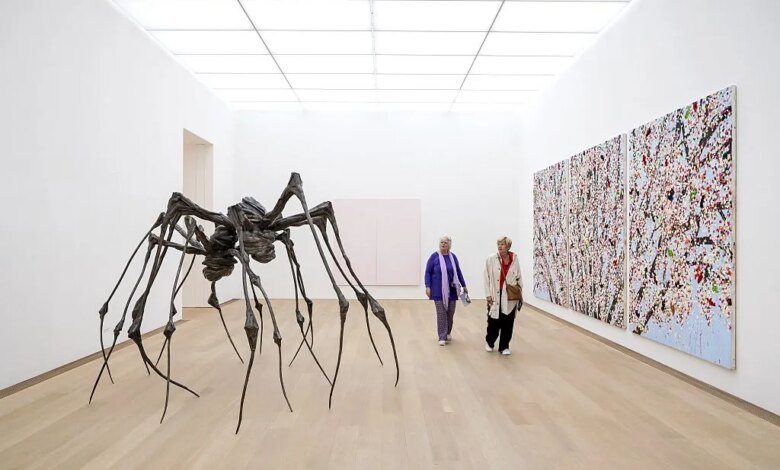
Inside, the architecture and curation are stripped of traditional distractions. The institution employs a “daylight museum” design, which emphasizes natural sightlines and acoustics over industrial climate systems or traditional wall texts that dictate what a visitor should think. In a radical move for a major art venue, the museum limits its display to approximately 100 works at any given time, including iconic pieces like Louise Bourgeois’s “Spider Couple” and Damien Hirst’s “Hidden Secret Blossom.” The logic is that art needs literal and mental room to breathe; the objective is to leave the visitor feeling charged rather than overloaded.

Practical interventions have proven that quietness can be as addictive as noise. One of the museum’s most successful initiatives is the “Silence on Socks” hour. Every Saturday and Sunday from 10 to 11 a.m., a limited number of visitors are invited to experience the galleries in total silence and without shoes. By removing the sound of footsteps and the requirement of social interaction, the institution has found that visitors naturally slow their pace and stay longer with individual pieces.
The impact of this environment was recently observed during the “Stillness in the Storm” exhibition, which was specifically designed to offer reflection in a chaotic world. Staff noted that as visitors entered the first gallery, their behavior adjusted almost immediately to the exhibition’s rhythm. Voices dropped, and the frantic urge to document every work with a smartphone appeared to subside.
While museums must still compete online for visibility and relevance, the “punk” attitude advocates for a strict boundary between the digital hook and the physical experience. By resisting the urge to mirror the attention economy’s frantic pace, institutions like Voorlinden are betting that the most valuable thing they can offer a modern audience is not more content, but the time and space to engage deeply with what is already in front of them.