London’s Iconic Oxford Street Transitions to Pedestrian-Only Zone in Retail Revitalization Push

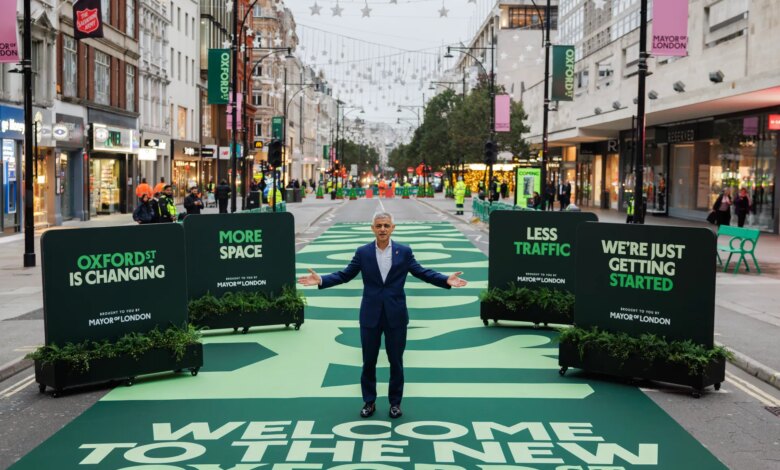
On a characteristically rainy and grey Monday morning in London, the rhythm of one of the world’s most famous thoroughfares underwent a historic transformation. For generations, Oxford Street has been defined by the constant churn of red double-decker buses, black cabs, and private cars. This week, that noise was replaced by the sound of umbrellas and footsteps as the section stretching from Great Portland Street to Orchard Street officially became a pedestrian-only zone.
While most shoppers initially stuck to the pavements by force of habit, the shift quickly began to change the atmosphere of the district. Muneera Alfadhel, a biology teacher who was among the first to walk down the center of the road, described the experience as “magical” despite the weather. Mark Arbouine, a forensic scientist taking advantage of the traffic-free lanes, noted that the change made the area significantly easier to navigate, calling it a victory for both the environment and the shopping experience.
The stakes for this transition are remarkably high. This single stretch of road, measuring roughly one kilometer, is a massive engine for the British economy, generating approximately 1 percent of the United Kingdom’s annual gross domestic product. However, Oxford Street has struggled in recent decades. Data from the retail trade body New West End Company indicates that footfall has dropped to just 57 percent of what it was in 2006. Faced with falling rents and reduced consumer spending, local authorities are looking to pedestrianization as a vital lifeline for the district’s survival.
Projections from the Greater London Authority suggest that even partial pedestrianization could generate more than $109 million in annual revenue and support approximately 700 new jobs. These estimates are supported by data from a trial run conducted in October 2025, during which two-thirds of local businesses reported sales figures that were either higher than or consistent with previous periods.
Environmental advocates have also praised the move. Barbara Stoll, a campaigner for walkable cities, observed that the air felt cleaner and the noise levels were considerably lower almost immediately after the traffic ban took effect. She compared the excitement of people emerging from the tube stations to children on Christmas morning, arguing that such projects across Europe have consistently proven to improve life for residents while reducing shop vacancies.
However, the project has not arrived without significant friction. The effort to pedestrianize Oxford Street has been a point of political contention for years. London Mayor Sadiq Khan first attempted the transition in 2017, but those plans collapsed in 2018 when the Westminster Council—the local authority then responsible for the street—withdrew its support, citing opposition from local residents. To bypass similar roadblocks this time, the Mayor established the Oxford Street Development Corporation, transferring control of the street from local officials to the Greater London Authority and Transport for London.
Critics argue that this administrative shift has marginalized the voices of those who live in the area. Councillor Tim Barnes, the deputy leader for growth and planning for the City of Westminster, characterized the communication process as a one-way street where residents are told what will happen rather than being consulted. He expressed concern that the economic benefits are being overstated and that the plan fails to account for the impact of displacing bus routes onto smaller, surrounding residential streets.
Local residents like Nerma Cridge have voiced fears that the West End will become “unliveable,” citing the potential for overcrowding and increased noise late at night. Some shoppers also raised concerns about accessibility, noting that the removal of bus stops along the main stretch could create difficulties for people with disabilities or those who struggle to walk long distances.
The current pedestrianization is only the first phase of a broader regeneration project. Future plans include the creation of two public squares, the planting of 50 trees, and the installation of hundreds of new public seating areas. The Oxford Street Development Corporation intends to monitor the results of this initial phase over the coming months, with a formal review of findings expected early next year. If the project remains on schedule, the remainder of Oxford Street is expected to transition into a permanent, traffic-free public space by the end of next year.