
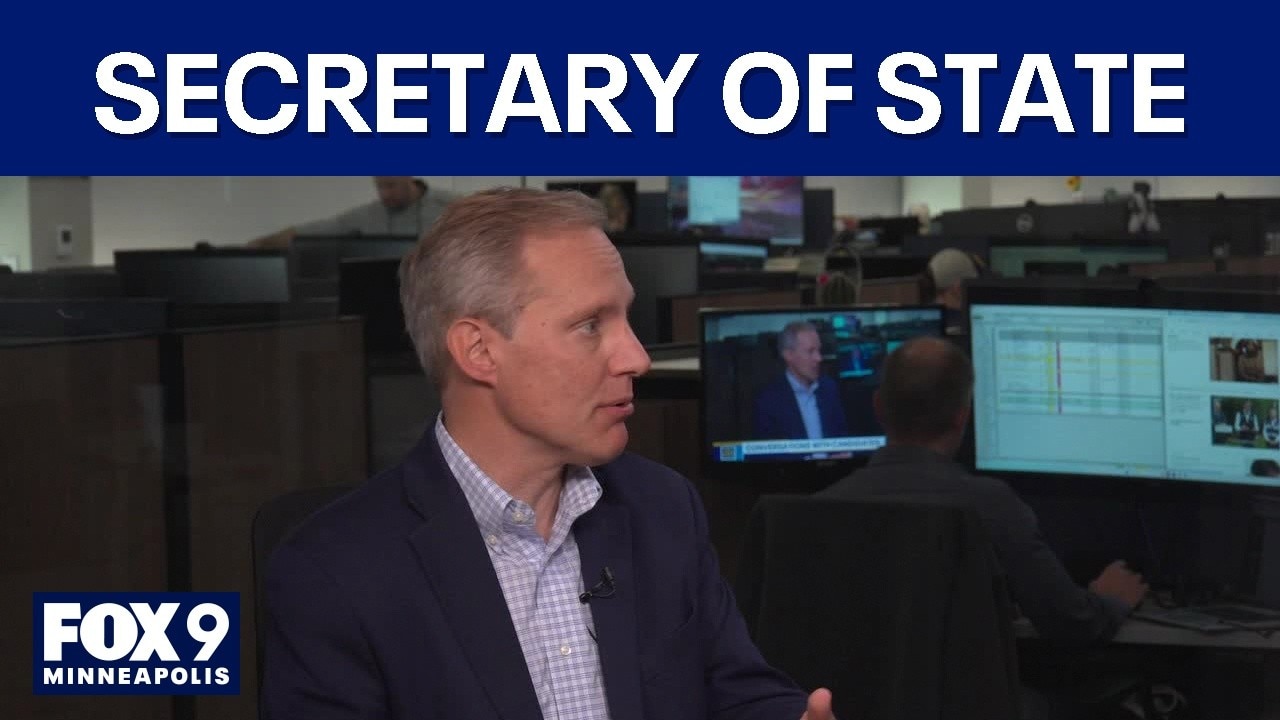
Minnesota Secretary of State Steve Simon, a Democrat campaigning for another term, recently discussed his approach to election administration, voter security, and ballot accessibility during a televised appearance with Rob Olson. Simon, whose Republican challenger Tad Jude has also appeared on the program, weighed in on several high-profile election administration debates, ranging from local voter identification proposals to national data sharing disputes.
Reflecting on his entry into public service, Simon pointed to his family history as a primary driver for his dedication to democratic institutions. He noted that his mother was an immigrant from Austria who grew up in a bilingual household, an experience that shaped his view on providing election materials in multiple languages. On his father’s side, family members fled Eastern Europe over a century ago and settled in northern Minnesota’s Iron Range. Finding a voice in local governance after leaving a region lacking fundamental rights left a lasting impression on him.
Turning to the ongoing debate over voter identification requirements, Simon emphasized that Minnesota voters previously rejected a constitutional amendment on the matter. He noted that the state already requires individuals to provide documentation proving identity and residency when registering to vote, utilizing a flexible system that accepts utility statements or neighbor attestations alongside government-issued photo IDs.
Balancing ballot access with administrative security remains a core challenge, Simon said. Drawing from his visits to all 87 Minnesota counties, where he occasionally surveys senior and assisted-living facilities, he observed that fewer than half of residents maintain a government-issued photo ID displaying their current local address. While acknowledging that providing free state-issued IDs would represent a step in the right direction for anyone lacking a driver’s license, he cautioned against moving too quickly on restrictions that might disenfranchise eligible voters.
On the subject of voter impersonation, Simon clarified that this specific form of fraud is exceptionally rare and microscopic in scale. He stated that individuals attempting such acts face a high probability of detection due to rigorous multi-database screening. Minnesota cross-references voter registration rolls and cast ballots with various databases to screen for non-citizens, double voting, and deceased individuals using two separate death databases.
Addressing past felony charges against activists James O’Keefe and Cam Higby related to alleged voter impersonation, Simon drew a distinction between protected political speech and unlawful conduct inside polling places. While defending First Amendment rights for political expression and demonstrations, he stressed that polling places must remain calm and orderly. He argued that video footage recorded by the activists actually underscored the security of the state’s system by mischaracterizing the legal definition of vouching. Simon explained that vouching in Minnesota applies strictly to verifying residency rather than citizenship or overall eligibility, and he noted that individuals using a voucher must still provide official identification numbers such as a driver’s license or partial Social Security number.
Simon also defended his office’s refusal to comply with a federal demand requiring states to turn over complete voter databases. Explaining that the state’s legal review determined the federal government was not entitled to sensitive information such as Social Security and driver’s license numbers, his office declined the request. The refusal led to lawsuits filed by the Justice Department against 34 states. According to Simon, federal courts have ruled unanimously in 27 cases, including in Minnesota, siding with the states and establishing that the federal government lacks entitlement to that specific level of sensitive data for its stated purposes.
Looking toward a potential new term, Simon outlined a dual approach focused on defense and offense. The defensive priority involves protecting voting freedom from external interference, while the offensive priority centers on expanding public transparency. Simon aims to open the inner workings of the state’s election systems further, allowing citizens to inspect administrative processes directly and verify system security.