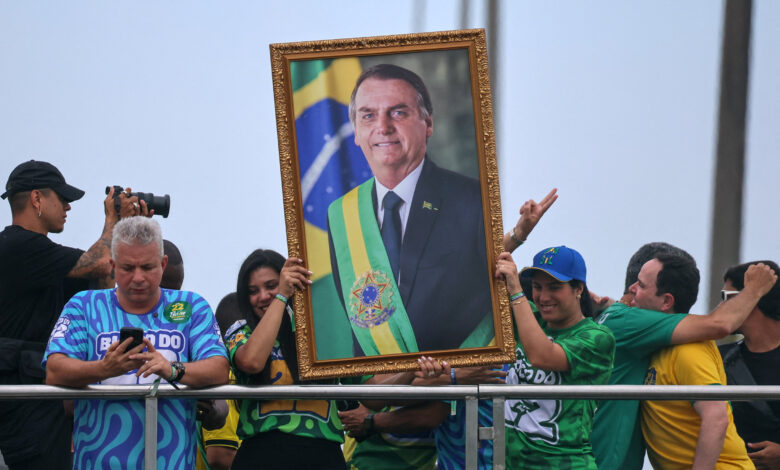
Two senior U.S. State Department officials led a sustained campaign to restore the right-wing Bolsonaro clan to political power in Brazil, successfully pushing for U.S. sanctions and punitive measures designed to influence the nation’s presidential election. The effort culminated ahead of a tight runoff vote between conservative Senator Flavio Bolsonaro and leftist incumbent President Luiz Inacio Lula da Silva.
The officials driving the strategy were Darren Beattie, a Senior Advisor for Western Hemisphere Affairs overseeing Brazil policy, and Ricardo Pita, who was promoted this year to Deputy Assistant Secretary for North America. Operating as political appointees, the two men held wide latitude over Washington’s diplomacy with South America’s most populous nation. In the months before campaigning began, they instructed U.S. diplomats in Brazil that official U.S. policy was to return former President Jair Bolsonaro to leadership, despite his disqualification from office for plotting a 2022 coup after losing the presidential election to Lula.
Following Jair Bolsonaro’s 27-year sentence in September 2025, Beattie and Pita pivoted their backing to his son, Senator Flavio Bolsonaro. The officials directed embassy personnel to avoid interacting with other conservative presidential contenders who could challenge the younger Bolsonaro. Former and current officials familiar with the matter noted that Beattie and Pita successfully advocated for aggressive U.S. measures intended to weaken Lula and boost the Bolsonaros.
The campaign’s policy levers included pushing for Magnitsky Act sanctions against Brazilian Supreme Court Justice Alexandre de Moraes, who spearheaded the criminal investigations into Jair Bolsonaro. In early 2025, Eduardo Bolsonaro, another son of the former president, lobbied Washington officials and met with Beattie at the State Department. Beattie subsequently appealed directly to the U.S. Treasury Department’s Office of Foreign Assets Control. Treasury Secretary Scott Bessent’s department ultimately announced Magnitsky sanctions against Justice Moraes in July 2025, citing alleged free-speech violations related to the jailing of Brazilians for political social-media posts and the censorship of U.S. social-media companies.
Justice Moraes had defended his actions as necessary to purge fake news that undermined public trust in Brazil’s democratic institutions. Although the Treasury Department imposed sanctions in July 2025, Justice Moraes was quietly removed from the Magnitsky sanctions list in December without an official explanation.
The strategy also involved lobbying for Washington to designate Brazil’s top criminal organizations, the Primeiro Comando da Capital and Comando Vermelho, as foreign terrorist organizations, a move the Bolsonaros believed would weaken Lula politically by highlighting crime concerns. Pita joined a U.S. delegation visiting Jair Bolsonaro in Brasilia in May 2025 and subsequently directed sanctions officials to explore terrorist designations. In May 2026, following Pita’s promotion, Flavio Bolsonaro met with Beattie and Deputy Secretary of State Christopher Landau in Washington to discuss the terrorist designation. The State Department announced the designation the following day.
Washington announced further measures in July 2025, including the revocation of visas for eight Brazilian Supreme Court justices and the imposition of 50 percent tariffs on Brazilian goods, citing the prosecution of Jair Bolsonaro. However, these steps faced immediate friction. Brazilian political analysts noted that the measures against the court failed to halt Bolsonaro’s trial, while the tariffs galvanized support for Lula and sparked intense pushback from major U.S. and Brazilian corporations dependent on bilateral trade, such as meatpacking giant JBS. Washington eventually watered down the tariffs.
Further friction arose when Brazil barred Beattie from entering the country in March to visit the imprisoned former president. Meanwhile, analysts suggested President Donald Trump avoided a public endorsement of the Bolsonaro campaign to prevent accusations of foreign electoral interference that could inadvertently aid Lula. Nonetheless, after Flavio Bolsonaro narrowly outperformed Lula in the first round of voting, Trump praised the outcome as a major victory.