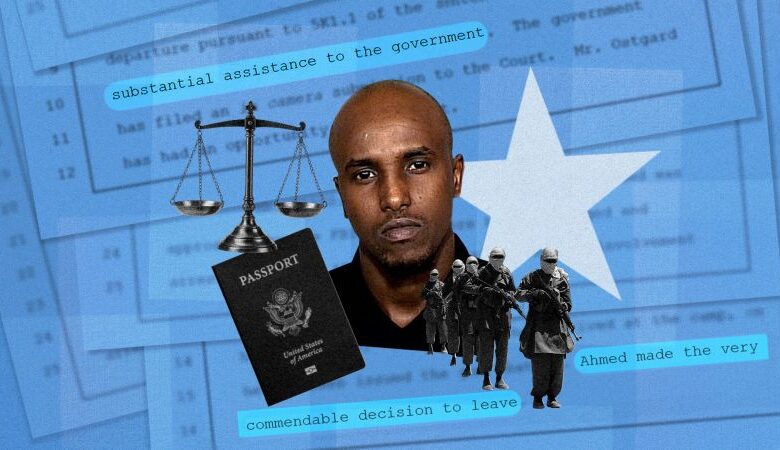
A federal denaturalization lawsuit unfolding in Minnesota has renewed intense debate over the limits of immigration enforcement, national security strategy, and the legal protections afforded to cooperating witnesses in terrorism investigations.
More than a decade ago, federal prosecutors lauded Salah Osman Ahmed for his substantial assistance to the government. Four years after pleading guilty to providing material support to terrorists and seven months after testifying as a cooperating witness in a high-profile trial, a judge received a government recommendation for a reduced sentence in May 2013. Prosecutors credited Ahmed’s post-arrest candor and noted he had made the cleanest break from al-Shabaab among all defendants in the investigation.
Today, a different team of federal prosecutors is asking a judge to revoke Ahmed’s U.S. citizenship. The civil lawsuit argues that because the 44-year-old spent months as an al-Shabaab recruit in Somalia during late 2007 and early 2008 shortly after naturalizing, he lacked the requisite attachment to the principles of the Constitution.
The case forms part of what Attorney General Todd Blanche has described as the largest denaturalization effort in modern history. Researchers indicate that more than 170 civil denaturalization lawsuits have been filed since the start of President Donald Trump’s second term, surpassing the total number filed over nearly two decades prior, according to data from the Transactional Records Access Clearinghouse through September 28, 2026.

While many recent denaturalization targets have serious criminal convictions, including child sexual abuse, fraud, and espionage, the action against Ahmed has drawn distinct scrutiny from legal scholars. Unlike typical cases that focus on pre-naturalization fraud or conduct, prosecutors are invoking a rarely used McCarthy-era statutory provision that permits using post-naturalization conduct and organizational affiliations within five years of gaining citizenship to prove a lack of constitutional attachment. Scholars note that no prior administration has pursued this specific provision so aggressively, raising constitutional questions and fears that it could eventually be applied to political opponents.
Ahmed’s defense attorney, Daniel Gerdts, has forcefully criticized the lawsuit, pointing out that Ahmed traveled to Somalia before al-Shabaab was officially designated as a foreign terrorist organization and that he was never a member of the group. Furthermore, Gerdts argued that the government should be barred from seeking denaturalization after previously praising and rewarding Ahmed’s substantial contributions to national security.

Former law enforcement and intelligence officials warn that targeting a cooperating witness for denaturalization and potential deportation carries severe national security consequences. They argue that future defendants and potential informants will refuse to cooperate with federal investigators if they believe their assistance will ultimately be met with the revocation of their citizenship and exposure to deadly retaliation in their home countries.
Legal experts note that cooperating witnesses are frequently indispensable in complex terrorism prosecutions where electronic surveillance and undercover operations fall short. Critics contend that undermining this investigative pipeline is a short-sighted policy that harms long-term counterterrorism efforts.
The Department of Justice has defended its actions, stating that officials follow the facts and the law in every case and that denaturalization remains a top priority to correct egregious violations of the immigration system. Meanwhile, legislative proposals such as the Deport The Terrorists Act introduced by Rep. Bill Huizenga aim to automatically denaturalize individuals convicted of terror-related charges, though that measure remains in committee.
As the litigation proceeds in the Minnesota District Court, prosecutors have moved to disqualify the assigned judge from hearing the case based on previous media comments regarding immigration initiatives, a motion that court spokespersons and defense counsel have defended and prepared to contest at a hearing scheduled for next month.