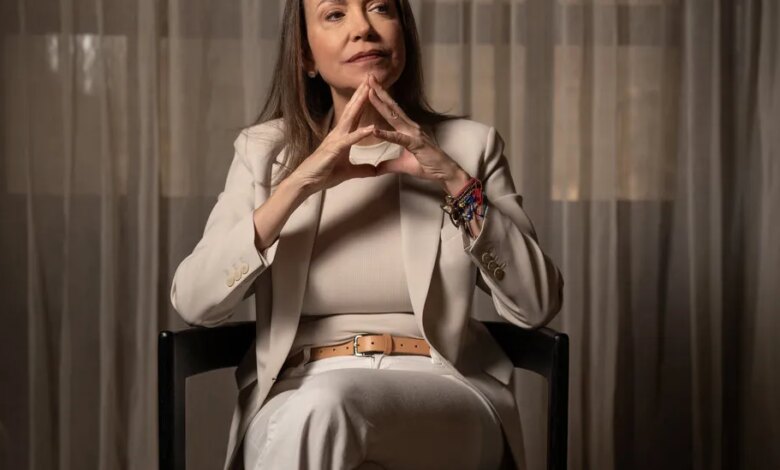
María Corina Machado, the prominent leader of Venezuela’s opposition movement, returned to her home country on Sunday, ending nearly a year of exile. Her return comes at a volatile moment for the nation, which is navigating the aftermath of a U.S. military intervention and recovering from catastrophic earthquakes that struck in June.
Machado, a conservative former legislator and 2025 Nobel Peace Prize recipient, had been living abroad since secretly leaving Venezuela following the contentious 2024 presidential election. Upon her arrival on Sunday, she signaled her intent to resume her political activities immediately, posting a brief message on social media: “I am here. With you all.”
The political landscape Machado returns to is vastly different from the one she fled. In January, just weeks after Machado traveled to Norway to receive the Nobel Peace Prize, the United States launched a military invasion of Venezuela. During the operation, Nicolás Maduro and his wife, Cilia Flores, were captured. The couple is currently in the United States awaiting trial on a range of charges, including narco-terrorism, drug trafficking, and the torture of political detainees.
Following Maduro’s capture, the United States threw its support behind Delcy Rodríguez, who was installed in the vice presidency following the 2024 election—a vote that Machado and many international observers argued was fraudulent. While Maduro’s removal ended years of socialist rule under his administration, it did not immediately clear a path for Machado’s return. Tensions remained high, and her previous attempts to enter the country were repeatedly blocked.
Machado, 59, is the daughter of a well-known family in Caracas and has long been a fixture of the Venezuelan opposition. Educated at an elite Catholic school in Caracas and a boarding school in Wellesley, Massachusetts, she holds degrees in engineering and finance. Before entering politics, she worked for her family’s steel company, Sivensa. In 2010, the company was partially expropriated by then-President Hugo Chávez as part of a sweeping nationalization program that targeted dozens of private firms.
Her political career began in the early 2000s when she co-founded Súmate, a voting rights organization that attempted a recall of Chávez. She eventually joined the National Assembly in 2010, securing a record number of votes. In 2023, she launched a presidential bid through her party, Vente Venezuela, but was ultimately barred from running by the Maduro government, which cited alleged financial irregularities. Machado dismissed the move as a political maneuver and threw her support behind Edmundo González, a former diplomat.
While Maduro claimed victory in the 2024 race, the opposition produced evidence suggesting González had actually won by a significant margin. The Norwegian Nobel Committee, in awarding Machado the peace prize, cited her commitment to democracy in the face of “ever-expanding authoritarianism.”
Despite her democratic credentials, Machado’s relationship with the current U.S. administration has been complex. She was a vocal supporter of the U.S. military buildup in the Caribbean and even presented her Nobel medal to Donald Trump during a meeting in January. While in exile, she promoted an economic recovery plan centered on privatizing the state-run oil industry, arguing that a transition to a market-led economy could generate $1.7 trillion in wealth over 15 years.
The Trump administration has already begun privatizing elements of Venezuela’s oil sector under Delcy Rodríguez, though Machado has criticized some of the resulting financial deals as opaque. Relations between Machado and Washington reportedly grew strained following the June earthquakes, when U.S. officials expressed concerns that her return might destabilize the country’s fragile recovery.
Official reactions to her arrival on Sunday were measured. Donald Trump described Machado as a “very nice woman” but did not explicitly endorse her leadership. Secretary of State Marco Rubio attributed the conditions of her return to U.S.-supported reconciliation efforts. Rubio emphasized that the United States expects the rights of all political sectors to be respected and urged all actors to participate in talks that represent a chance for “an enduring democracy,” though he did not provide a specific timeline for new presidential elections.
David Smolansky, a spokesman for Machado, characterized her return as a major milestone toward a “democratic transition and free, fair and verifiable presidential elections in the near future.”