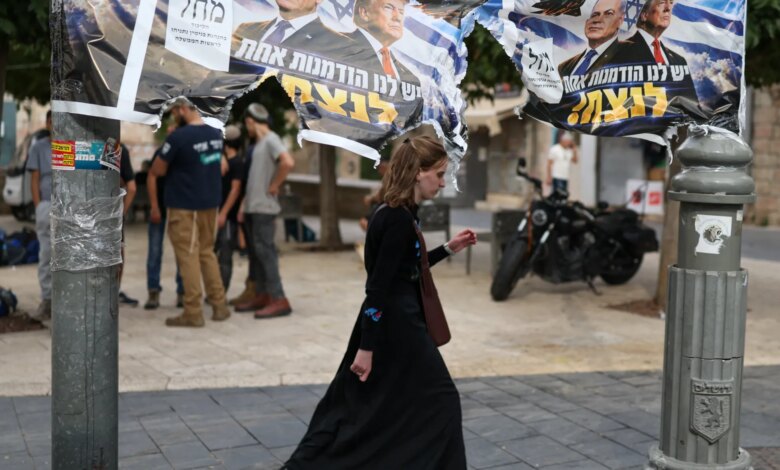
Israel’s national election has ended in a deadlock, with nearly 90 percent of ballots counted and neither major political bloc securing the 61 seats required to form a governing coalition in the 120-member Knesset.
The Israeli Central Elections Committee reported that more than five million votes had been tallied by Wednesday evening at 9pm local time. Projections indicate that Prime Minister Benjamin Netanyahu’s political bloc is positioned to win 53 seats. Meanwhile, the opposition alliance headed by Gadi Eisenkot is projected to capture 48 seats.
The ballot marked the first national vote since the October 7, 2023, attacks, serving broadly as a referendum on Netanyahu’s long-standing premiership. Despite falling short of an outright majority, the 77-year-old incumbent remains caretaker prime minister while coalition dynamics play out. Final election results are anticipated as early as Thursday evening, though analysts note that more than 500,000 special double-envelope ballots—cast by soldiers, diplomats, and voters away from registered stations—still need to be counted and could shift the final seat distribution.
Arab political parties, including the Joint List and Ra’am, are projected to hold a record combined 19 seats following a surge in voter turnout. Both Netanyahu and Eisenkot previously ruled out forming a minority government backed by Arab parties. Given that no party in Israeli history has ever won an outright majority, political observers suggest Netanyahu may pursue a unity government incorporating Eisenkot’s alliance, though such an outcome remains uncertain.
President Isaac Herzog is scheduled to begin formal consultations with party leaders next week regarding the formation of a new administration once official results are published. Herzog has publicly urged political factions to avoid triggering another election that could further stall governance.
Following Wednesday’s updates, Eisenkot addressed supporters on social media, emphasizing his bloc’s mission to establish a new administration and criticizing the current leadership. In contrast, Netanyahu’s Likud party leveled serious allegations regarding the integrity of the vote, accusing Arab parties of electoral theft through alleged bribery, threats, violence, forgeries, and prohibited software usage. Likud stated it was forwarding hundreds of testimonies and evidence packages to the police, the Shin Bet, and the Central Elections Committee.
Arab political leadership rejected the allegations. The Joint List issued a statement maintaining that high Arab voter turnout proved decisive in keeping Netanyahu’s coalition from achieving a parliamentary majority. Joint List leader Yousef Jabareen stated that the alliance would consider supporting an anti-Netanyahu government from the outside without officially joining the coalition.