Clashes erupted in Paris as a mass march drew to a close Saturday, with more than 400,000 people rallying across France over school funding and soaring living costs in a fresh challenge to President Emmanuel Macron. Police made nearly 1,000 arrests, according to government figures.
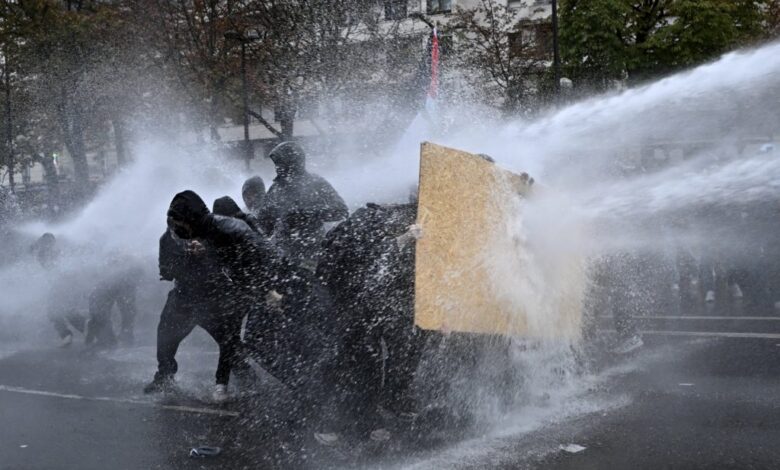
The Paris march began peacefully a week after widespread rioting and looting during demonstrations across the country. Near the demonstration’s endpoint in eastern Paris, masked protesters hurled objects and fireworks at police, who answered with clouds of tear gas, deafening sound grenades, and water cannons. Officers with megaphones urged demonstrators to disperse, while tear-gas canisters landed in their midst and scattered panicked crowds. Veteran protesters shouted after those fleeing to stand their ground.
The Interior Ministry put nationwide turnout at 410,000, down from the 550,000 it reported protesting the previous weekend. The CGT union, which helped organize some of the demonstrations, estimated turnout at nearly 800,000. The ministry’s figures included 110,000 protesters in Paris, where authorities confined the march to the city’s southeastern edge, away from the center. The CGT estimated the Paris turnout at 250,000.
The unrest is testing Macron’s authority in the final months of his presidency before voters choose his successor in May. The political stakes are high as the far-right National Rally party accuses the government of failing to protect the public and urges citizens to channel their anger into votes for candidate Marine Le Pen. On the far left, presidential candidate Jean-Luc Mélenchon has backed demonstrators and criticized policing tactics that have left some teenage protesters with life-changing injuries.
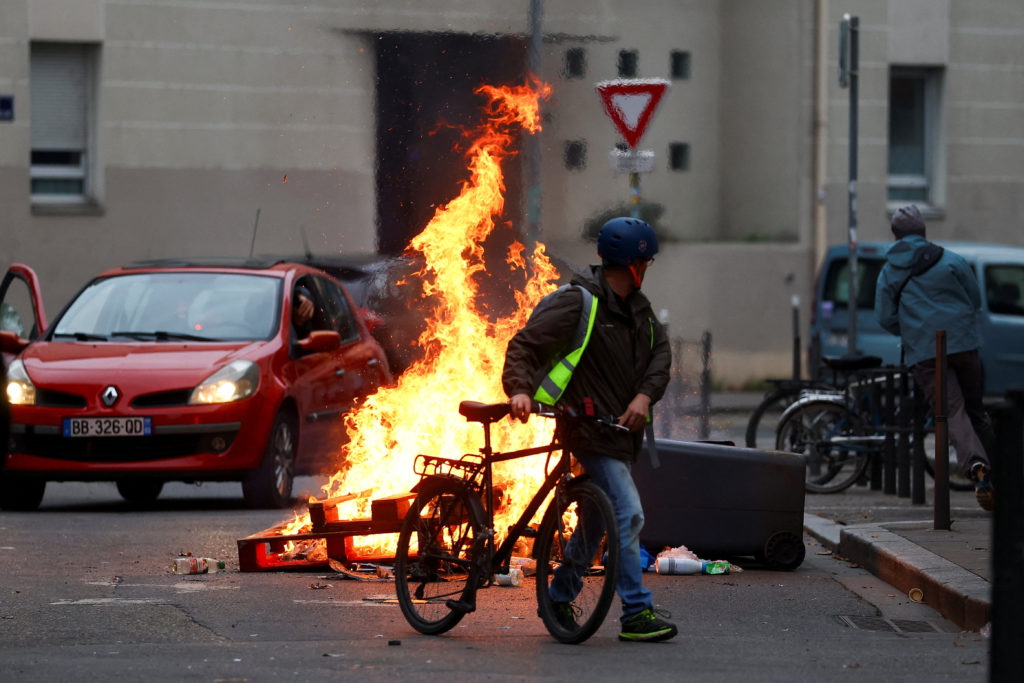
As dusk fell Saturday, violence broke out at the end of some of the 289 protests counted nationwide by the Interior Ministry. Street fires burned in Marseille and Lyon, while police deployed tear gas in Lyon, Clermont-Ferrand, Strasbourg, and Bordeaux, and water cannons in Nice and Nantes. In Nice, far-right extremists fought with downtown demonstrators, resulting in 11 arrests according to regional authorities.
Interior Minister Laurent Nuñez stated that police made nearly 1,000 arrests and warned that the total is expected to rise significantly as more are counted. Nuñez credited beefed-up policing—involving 70,000 officers supported by helicopters and armored vehicles—with preventing a repeat of the widespread looting and shop damage seen the previous weekend.
What began last month as a protest over staff shortages at a single high school southeast of Paris has expanded into a national movement, drawing students demanding increased educational funding and workers seeking relief from soaring costs for fuel and daily necessities. In Paris, 46-year-old teacher Bénédicte Pittion marched with her 16-year-old high school student daughter, Garance, marking their first joint protest. Although Garance admitted feeling terrified after witnessing the previous weekend’s violence, she felt staying away would hand the government a victory.
Macron met with high school representatives on Friday. While officials said he promised to overhaul university admissions, student groups called for protests to continue until concrete measures are formally announced. Soumaya Abed, a 58-year-old nurse wearing a red CGT union vest, criticized authorities for attempting to stifle protesters by confining the march to the capital’s outskirts and keeping them away from the center, where major cultural sites like the Louvre closed exceptionally.
Other demonstrators voiced frustration over record poverty and wealth inequality. Camille Chesnier, a 27-year-old with an engineering degree and a master’s degree, said she has been unable to find work. Thousands also marched in Marseille, where police recorded 17,000 participants while the CGT estimated 100,000, and in Toulouse, where authorities reported 26,500 attendees. Authorities had banned rallies in cities including Lyon, Nice, and Montpellier, drawing criticism from trade unions that called the bans violations of constitutionally protected freedom of expression. Meanwhile, thousands marched in Orléans in a separate peaceful protest against the far right as Le Pen’s National Rally held a two-day congress in the city.
Security remained tight across Paris, with gendarmes standing guard beneath the Arc de Triomphe and shopkeepers boarding up storefronts. Near the Saint-Lazare train station, contractor Akram Ahmed spent Saturday boarding up an optician’s shop after receiving an urgent call from a desperate owner. The threat of unrest also prompted organizers of Art Basel, one of the world’s most prestigious contemporary art fairs, to cancel its weekend program after opening to the public for just one day on Friday.
Student groups have outlined a 10-point plan demanding 250,000 additional places in higher education, an end to selection through the Parcoursup national admissions system, more teachers, and repairs to dilapidated school and university buildings. They are also seeking financial relief through an extra 200 euros ($224) a month in student grants and a rent freeze in public student housing. These demands come amid broader economic pressures; energy prices in France were 21.3% higher in September than a year earlier, driving overall inflation to 3.1% according to national statistics agency INSEE. Paris protester Louis Ledoux-Xatard expressed frustration over growing inequality, noting concerns about societal trajectories and the frequency with which young adults are compelled to take to the streets.