Federal Reserve Holds Interest Rates Steady Amid Rare Dissents and Inflation Pressures

The Federal Reserve voted to leave interest rates unchanged as central bank officials look for additional economic data to determine whether further monetary tightening is required to control inflation.
The decision was not unanimous. Two officials broke from their colleagues to advocate for a quarter-percentage-point rate increase: Cleveland Fed President Beth Hammack and Federal Reserve Governor Lisa Cook. Cook’s vote marked a notable departure, as she had not previously dissented during her tenure on the Fed board.
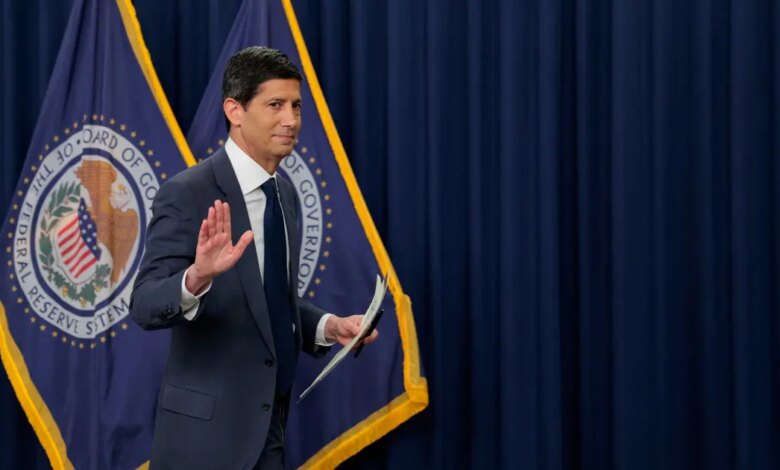
Following the announcement, Fed Chair Kevin Warsh adopted a hawkish stance during a press conference with reporters. “If you think that we’re tolerating some inflation target somewhere [above 2%], let us disabuse you of it,” Warsh stated. He also announced a structural change to the central bank’s schedule, revealing that the Fed will reduce its voting meetings by one per year starting in 2027 to afford officials more time for strategic deliberations.
The rare dissents have reinforced market expectations that the central bank may pursue a rate hike in December. Continued conflict involving Iran has pushed energy costs higher, complicating an economic landscape where other indicators remain more favorable.
The decision comes against a backdrop of pressure from the Trump administration, which had cautioned the central bank against adjusting rates ahead of upcoming midterm elections. Addressing reporters, Warsh maintained that political considerations had no bearing on the policy outcome. “I just spent two days with my colleagues upstairs; I didn’t hear an utterance about politics,” Warsh said.
Simultaneously, political friction surrounds Governor Cook. The administration recently revived efforts to remove her from office, renewing allegations of mortgage fraud as part of a broader campaign advocating for lower borrowing costs. In connection with these allegations, the White House has requested Cook’s appearance at an unusual private hearing scheduled for next week. Warsh indicated that, to his knowledge, neither he nor the Federal Reserve would participate in those proceedings.
During the press conference, Warsh addressed several internal initiatives and external economic factors, including the rapid expansion of artificial intelligence. He noted that task forces established under his leadership may not conclude their work by the end of the year as originally projected, though he confirmed plans to attend a hearing next month held by the Fed task force dedicated to AI.
Governor Cook noted in a speech last month that the massive infrastructure buildout surrounding artificial intelligence is contributing to inflationary pressures, though she observed that the impact has largely remained concentrated within the technology sector. Warsh suggested that elevated interest rates are currently exerting a cooling influence on the AI sector as investors exercise greater caution toward technology borrowers.
“What are the implications for the dual mandate?” Warsh asked, noting his expectation that the upcoming AI task force hearing would provide clarity on whether the technology boom will complicate or assist the central bank’s efforts to maintain price stability in the coming years.