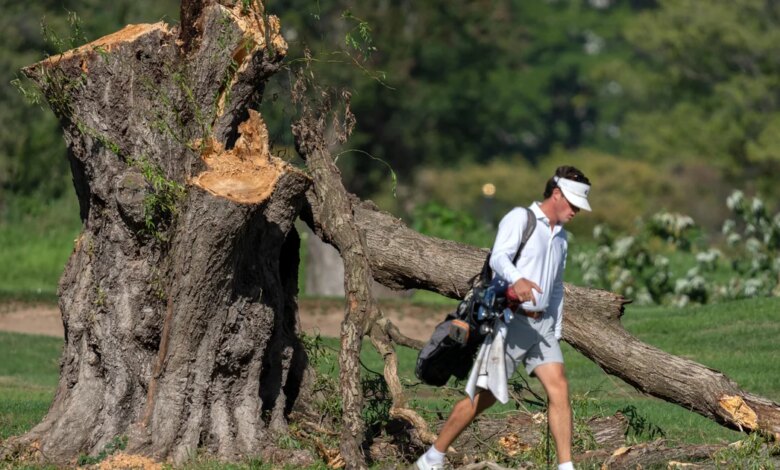
A federal judge on Monday barred the Trump administration from removing trees from East Potomac Golf Links in Washington, D.C., extending an ongoing legal battle over plans to overhaul the publicly owned property.
“The Court earlier stated, ‘I am not the Lorax. I do not speak for the trees,'” U.S. District Judge Ana Reyes wrote in a 70-page preliminary injunction ruling. “The Court still does not speak for the trees. It speaks only for the rule of law.”
The preliminary injunction prohibits the federal government from “removing or damaging” any trees on the golf course while a lawsuit challenging the renovation plan proceeds through the court system. Additionally, the judge mandated that the government provide 10 days’ notice before making “any irreparable modification” to the course. The order follows a temporary block previously put in place by the court.
President Donald J. Trump sharply criticized the ruling in a Truth Social post, calling the decision “unconstitutional” and stating that his administration would appeal. He also confirmed plans to close the course on November 15.
“To have to give advanced notices to a judge who has no expertise in Golf, Architecture, Landscaping, Construction, or anything else having to do with building such a World Class Project, is not fair, appropriate, or Constitutional,” the president wrote, arguing that the project is “totally ‘as of right.'”
The legal challenge was brought by the D.C. Preservation League, which sued over planned changes to the riverside course. The group argued that the government violated the National Environmental Policy Act by failing to conduct required environmental impact analyses.
Judge Reyes noted that she initially hesitated to intervene in the dispute, writing that she “would much prefer not to have to resolve Lorax v. Once‑ler redux.” However, she explained that intervention became necessary “because the Government did what it assured all it would not do,” pointing to the felling of hundreds of trees earlier this month with minimal notice to the court or plaintiffs.
According to the ruling, the government removed nearly 430 trees in a single day after providing notice at 4:55 p.m. on the Friday of a holiday weekend, and would have destroyed hundreds more had a rain delay not intervened. In total, over 500 healthy, non-invasive trees were targeted.
In her decision, Reyes rejected the government’s argument that the tree removals constituted routine, unrelated maintenance, concluding instead that they were part of the broader renovation scheme. She also stated she found testimony from the Department of the Interior’s deputy chief of staff unconvincing, including characterizations of the tree management plan as merely “cleaning up” the course.
The judge highlighted a stark contradiction between the administration’s public statements and the defense presented by government attorneys in court. While the president insisted the course would close for construction immediately and reopen in 15 months, Department of Justice lawyers argued it was legally premature to challenge the plans because no final decision had been reached.
“Rarely, if ever, has the United States Department of Justice urged a federal court not to believe the sitting President,” Reyes wrote. “This started as a case about golf. That good walk spoiled. But it has become much more. It now forces the Court to reconcile assertions by President Donald J. Trump with the sworn testimony of multiple government employees and the argument of senior Department of Justice attorneys.”
Earlier in the proceedings, after more than 430 trees were cut down, Reyes informed government lawyers that they had “lost credibility” and expressed that she was “furious” and “thoroughly unamused.”
In response to the tension, the Trump administration formally asked Reyes to recuse herself from the case, accusing her of “open hostility” and arguing that her “histrionics in prior hearings have clearly demonstrated she is no longer impartial.” Government attorneys cited instances where they claimed the judge unfairly questioned their intelligence and disregarded the separation of powers.
Judge Reyes rejected the recusal request, denying any bias and pointing to compliments she had previously offered to government counsel.
Mr. Trump has previously feuded with Reyes, referring to her as a “crazed lunatic” amid the escalating dispute over the future of the municipal golf course, which sits along the Potomac River and which the administration aims to transform into a championship-caliber venue for professional tournaments.