Israel Holds High-Stakes Legislative Election to Decide Prime Minister Benjamin Netanyahu’s Political Future

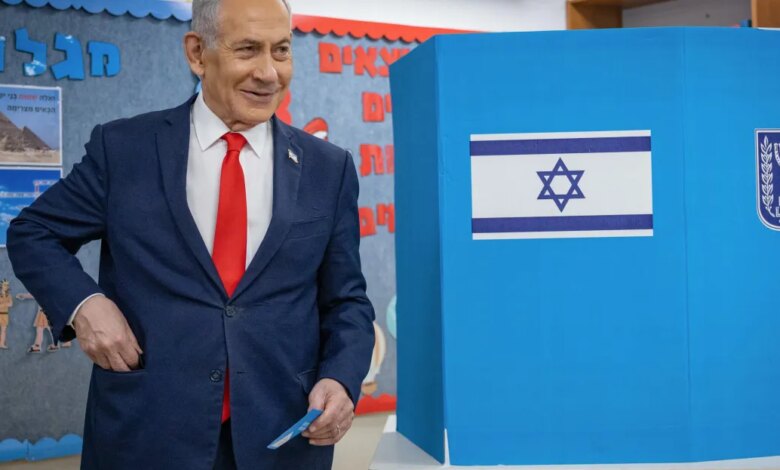
Voters turned out in record numbers across Israel on Tuesday for what analysts have described as one of the most consequential legislative elections in the nation’s history. The vote serves as a definitive referendum on the events following the October 7, 2023, attacks, including the devastating military campaign in Gaza, a widening regional conflict, and Prime Minister Benjamin Netanyahu’s ongoing challenges to independent watchdogs, foreign media, and his political opposition.
Both Netanyahu and his political rivals have framed the election in existential terms. Campaign banners for Netanyahu’s right-wing Likud party warned voters that they could choose a nationalist platform or face Palestinian rule, while opposition leaders characterized the ballot box battle as an essential fight to preserve the fundamentals of Israeli democracy. The outcome will determine whether Netanyahu extends his long tenure in power or if a new governing coalition emerges.
The election arrives against a backdrop of deep institutional and societal tensions. The immediate political threat centers on Netanyahu’s more authoritarian impulses, with critics warning that securing a record seventh term would grant him expanded leverage to weaken remaining checks and balances on executive power. Simultaneously, the country faces a foundational challenge regarding political representation. The state governs millions of Palestinians who lack national voting rights, while Israel’s Arab citizens, who comprise approximately one-fifth of the population, experience systemic discrimination across areas such as housing, land use, and family reunification.
This structural marginalization directly impacts parliamentary arithmetic. Leading figures across both Netanyahu’s camp and several opposition parties have repeatedly vowed to exclude Israel’s Arab parties from any governing coalition. Under Israel’s parliamentary system, citizens cast ballots for individual parties, and seats are allocated proportionally. Parties then negotiate to assemble a coalition capable of commanding a parliamentary majority.
A potential Netanyahu coalition is expected to rely on right-wing, nationalist, and ultra-Orthodox factions, whereas an opposition bloc would likely comprise left, center, and center-right Jewish parties. Polls closed at 4 p.m. ET, and election officials anticipate a clearer picture of the seat distribution as vote tallies continue into the evening. If neither major bloc secures enough seats to govern outright, the opposition might face the difficult choice of seeking support from Arab parties that its leaders previously ruled out. Should all coalition efforts fail, the nation could face the prospect of holding yet another round of elections.