French Unions and Protest Groups Call for Fresh Rallies and Strikes as Macron Faces Fiscal Pressures

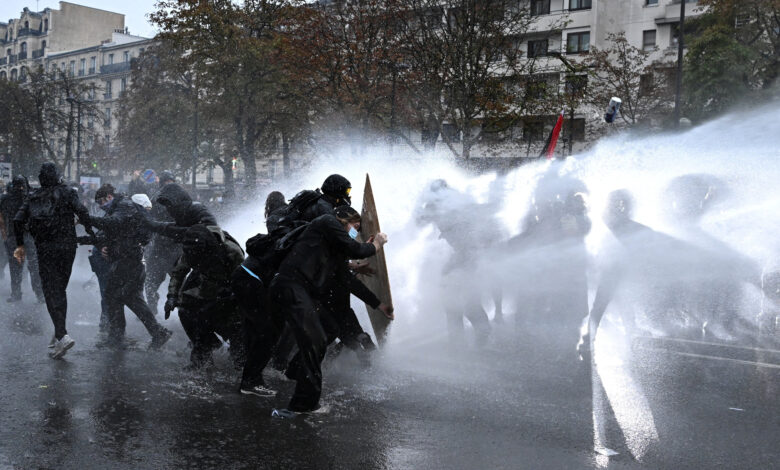
French protest groups and labor unions called on Sunday for a new wave of nationwide demonstrations and strikes, seeking to maintain intense pressure on the government following a massive security operation that helped contain unrest during large-scale rallies on Saturday.
The Interior Ministry reported that 410,000 people participated in Saturday’s marches. Authorities deployed 70,000 police officers across the country, a heavy security presence that helped avert a repeat of the widespread looting and vandalism that had swept many French cities on October 17.
Despite the relative containment, labor leaders urged supporters back into the streets for further protests next Saturday, followed by a coordinated nationwide strike on November 5. Union representatives argued that public frustration over stagnant wages, rising living costs, and declining public services has expanded far beyond the student movement that initially mobilized the demonstrations last month.
“We see an aggregation of anger,” Murielle Guilbert, co-leader of the left-wing Solidaires trade union federation, told BFM TV, noting that grievances originating from students, workers, firefighters, and other demographic groups are rapidly converging. Guilbert added that protest leaders have received no meaningful response from the administration, dismissing the measures proposed so far as inadequate.
Other labor and activist groups quickly joined the call for escalation. The SUD Education teaching union announced it would participate in an October 31 demonstration, while the large CGT union indicated it would finalize its official stance during the week. Meanwhile, the Yellow Vests—a grassroots movement that first emerged in 2018 in revolt against fuel taxes—also called for mass rallies next Saturday, including planned sit-ins outside town halls and the National Assembly.
“There is anger in this country,” activist Azelma Sigaux told reporters. “It’s growing in schools and universities, on roundabouts, in neighbourhoods, on farms and in workplaces.”
The resurgent unrest places President Emmanuel Macron in a difficult political and economic dilemma. When the Yellow Vests staged widespread protests in 2019, Macron’s government was able to secure the necessary financial resources to reduce fuel costs and defuse tensions. Seven years later, severely strained public finances leave the administration with virtually no fiscal room to meet the protesters’ extensive demands.
Political complications further compound the crisis for the executive branch. Macron’s presidential mandate expires next April, and his centrist party currently lacks the legislative majority required to pass major reforms or spending measures. Although the government has initiated talks with trade unions and student representatives in an effort to defuse the brewing crisis, protest leaders maintain that official offers fall far short of addressing public grievances.
Law enforcement authorities also warned that current deployment levels are unsustainable. Police unions stated on Sunday that departments lack the personnel required to maintain the exceptionally high staffing levels indefinitely. Saturday’s heavy policing limited disorder to sporadic clashes in several urban centers, including Paris and Marseille.
According to interior ministry figures released on Sunday, approximately 1,314 people were arrested during Saturday’s demonstrations—roughly half the arrest total recorded the previous week. About 50 police officers sustained injuries during the clashes, a sharp decline compared to more than 1,000 police injuries reported the prior week.
The social discontent has also resonated beyond France’s borders, sparking sympathy and parallel demonstrations in neighboring European nations. On Saturday, Belgian police deployed tear gas and pepper spray after clashing with anti-government demonstrators in Brussels. In Albania, peaceful protests that began in late May turned violent this month, while skirmishes erupted in several Italian cities for the second consecutive week.