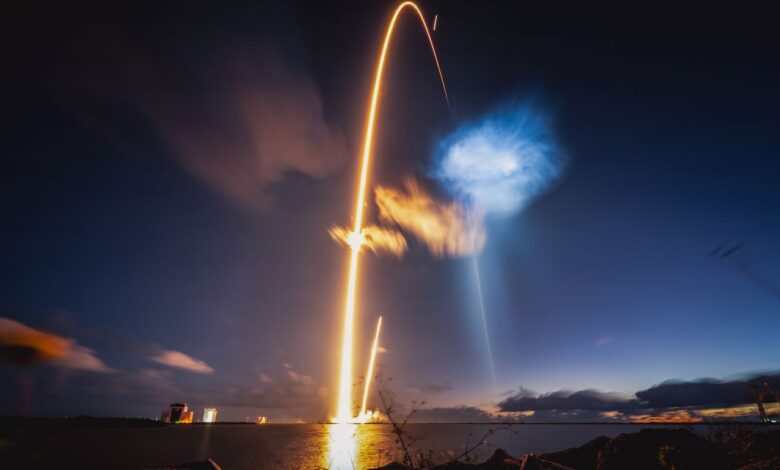
Rocket launches from Cape Canaveral, Florida, have officially surpassed the activity levels of the Cold War-era space race that originally established the site’s global reputation. This surge forms part of a broader U.S. effort to expand the country’s roster of rocket providers and maintain a competitive edge amid an ongoing space and arms race with Beijing. China has accelerated the development of its satellite and rocket fleets alongside plans to land a crew on the moon by 2030 or earlier.
Space Force Col. Brian Chatman, commander of Florida’s rocket range, described the current scale of operations as unprecedented in his professional background. Operations at the installation are scaling up to support a directive aiming for 1,000 annual U.S. launches by 2030. This rapid expansion has generated logistical challenges on the base, including parking congestion and inspection bottlenecks amid an influx of contractors.
Several major initiatives are currently underway across the facility. SpaceX is extending its footprint to accommodate Starship super heavy-lift launchpads, while newcomers Relativity Space and Stoke Space establish their facilities ahead of planned military and commercial launches slated for late 2026 and 2027. NASA is preparing for Artemis III testing missions and the Artemis IV voyage targeting a crewed lunar landing by 2028. Additionally, Blue Origin is actively rebuilding its launch complex following an explosion of its New Glenn rocket in May.
Jamie Draper, director of the Cape Canaveral Space Force Museum, noted that the base has navigated multiple historical fluctuations, observing that current conditions firmly reflect a major growth period.
Activity figures underscore the historic pace. Last year, Space Launch Delta 45, the military command responsible for overseeing the Cape, supported 109 orbital liftoffs, marking a historic high for the base. In April, the command oversaw five distinct rocket launches for separate missions within a single month, breaking a record previously established during the peak of the 1960s space race. Projections outlined in the service’s vision plan suggest annual launches could climb from the 2025 level to approximately 1,200 by 2036.
Despite this growth, capacity limits remain a central concern. With only two military spaceports operating nationwide—alongside California’s Vandenberg Space Force Base—existing infrastructure cannot fully accommodate the anticipated surge in commercial and military demand. Senior military officials have emphasized the necessity of establishing a third U.S. spaceport.
Lt. Gen. Philip Garrant, head of Space Systems Command, indicated that an additional spaceport will likely be required by 2030. To help alleviate this pressure, SpaceX plans to begin construction next year on a new offshore site off the Louisiana coast, targeting its first Starship launch from the location by 2029. Brian Weeden, director of civil and commercial policy for the Aerospace Corporation’s Center for Space Policy and Strategy, noted that the planned Louisiana site would help relieve considerable operational pressure on Cape Canaveral.
Until alternative launch sites become operational, Cape Canaveral will continue to serve as the primary anchor for the nation’s rocket enterprise, though military leadership maintains that broader national infrastructure expansion remains essential to meet long-term demand.