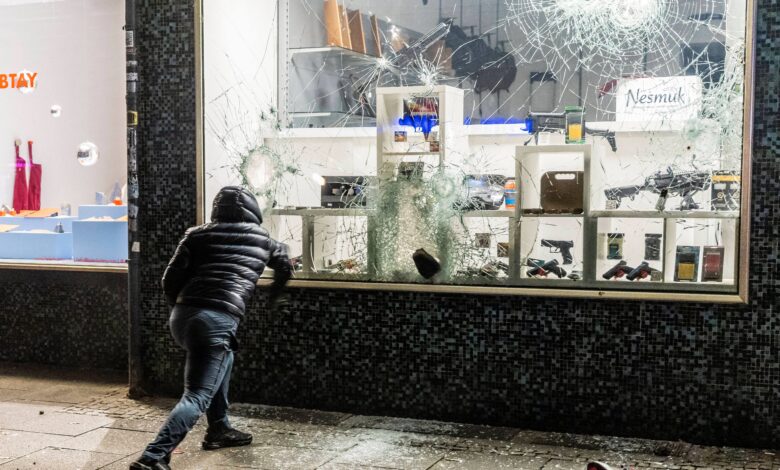
Demonstrations organized by youth campaign groups turned violent in Frankfurt late Saturday, resulting in looted storefronts, smashed windows, and clashes with emergency services as tens of thousands took to the streets across Germany.
The protests, part of a broader wave of youth-led activism sweeping Europe, were coordinated by the campaign group “Gen Z regelt” (“Gen Z takes charge”). The movement has mobilized young people in 34 cities—including Berlin, Munich, and Frankfurt—to demand greater investment in education, lower living costs, and an end to compulsory military service.

In Frankfurt, Germany’s financial hub, the unrest escalated sharply. At least two stores were looted, several others suffered physical damage, and rioters threw Molotov cocktails at emergency personnel. Frankfurt police urged citizens via social media to avoid the city center as disturbances continued. In Hamburg, protesters set barricades on fire, while businesses in multiple cities, including along Berlin’s luxury Kurfuerstendamm boulevard, boarded up their windows and planned early closures ahead of the demonstrations.
Official turnout figures fell short of organizers’ initial projections of 182,000 participants. Police in Berlin, Munich, and Frankfurt reported a combined total of roughly 18,000 demonstrators, about half the 36,000 figure claimed on the organizers’ website. While German authorities noted that the demonstrations—which coincided with Halloween festivities—were largely peaceful overall, they warned that extremist factions were attempting to exploit the movement.

Federal interior ministry officials reported that elements of Germany’s far-left extremist scene and groups linked to foreign movements had joined the mobilization. Hesse Interior Minister Roman Poseck voiced strong concern over the escalation, comparing the scenes to civil unrest in France. “We all have those images from France in our minds—looting, burning houses, burning police vehicles, and attacks on police officers,” Poseck said. “France must not be held up as a model in this regard.”
Organizers defended the demonstrations as a necessary pushback against economic pressures in Europe’s largest economy. Germany has faced sluggish economic growth, mounting pressure on pensions, and strained public services as the working-age population shrinks and baby boomers retire.

“We are here today to fight for peace and freedom, rather than for war and coercion,” said Lina Friedrich, a spokesperson for Gen Z regelt in Berlin. “What matters most to us is better support for the health and education systems. We are against compulsory military service and we are in favor of a fairer distribution of the burden.”
Addressing Chancellor Friedrich Merz at a Munich rally, an 18-year-old speaker named Steve criticized the government’s fiscal policies. “The government has offered no response to our concerns other than to continue making cuts and piling further burdens upon us,” he said. “We will continue to exercise our fundamental right to assemble until you stop ignoring us.”

Questions have also arisen regarding the campaign’s leadership and broad coalition, with Germany’s national school student umbrella organization, BSK, distancing itself from the initiative and scheduling a separate protest for November 20. Meanwhile, student participants emphasized tangible grievances, such as deteriorating campus infrastructure. Sean Baker, a student at the Technical University of Berlin, noted that university buildings suffer from severe neglect. “When you go inside and enter the rooms, it looks like an abandoned building,” Baker said. “Yet this is where we’re expected to study on a regular basis.”