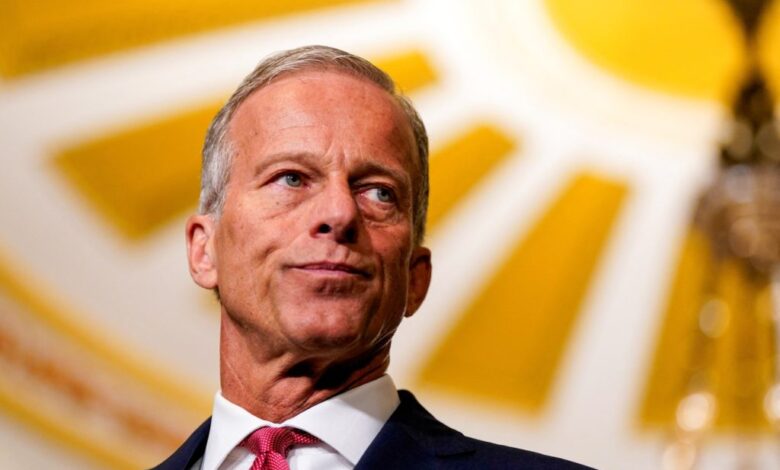
Senate Majority Leader John Thune finds himself navigating political crosscurrents as he travels across the United States to campaign for Republican candidates in marquee Senate races, working to preserve his chamber’s narrow majority ahead of the midterm elections. While acknowledging that he has faced criticism from the party’s base and President Donald Trump over stalled voter legislation, Thune has maintained an active travel schedule supporting candidates in traditionally safe red states that have unexpectedly transformed into competitive battlegrounds.
During a joint campaign swing through northwest Iowa, Thune joined Representative Ashley Hinson, who is locked in a competitive contest against Democrat Josh Turek to succeed retiring Republican Senator Joni Ernst. Their itinerary included a chamber of commerce luncheon in Sioux City, a tour of the Iowa Air National Guard refueling wing, a business roundtable, and meet-and-greets at a local high school football game. Thune emphasized the pivotal nature of the Iowa race, noting that retaining the seat is essential for the party to maintain its Senate control amid a challenging national political environment.
The electoral landscape for Republicans has grown increasingly complex as voters voice persistent frustrations over economic conditions, high gasoline and grocery prices, and the ongoing war in Iran initiated by the administration. Despite a political map that initially favored the GOP, Democrats view the Senate as an attainable pickup opportunity. Challengers like Turek, a state legislator, are positioning themselves as bipartisan voices in Washington, appealing to voters concerned about farm input costs, childcare, and trade disputes.
Beyond Iowa, Thune has campaigned extensively in states including Nebraska, Georgia, North Carolina, South Carolina, Mississippi, Kentucky, Florida, Minnesota, and Ohio, where Republican Senator Jon Husted faces a robust challenge from former Democratic Senator Sherrod Brown. Thune’s widespread presence marks a notable evolution since his election two years ago to succeed Kentucky Senator Mitch McConnell as conference leader.
Tensions have occasionally surfaced between Thune and the White House, particularly over the Senate’s refusal to discard the legislative filibuster to pass the SAVE America Act, which would mandate nationwide voter identification and proof of citizenship. Trump has publicly pressured Thune to alter Senate rules to bypass the 60-vote threshold, but Thune has steadfastly refused, arguing that the procedural safeguard is necessary to block future Democratic legislation if Republicans lose power. Despite friction that peaked during the summer when Trump publicly questioned his leadership, Thune retains strong backing from his Senate conference and maintains cordial personal interactions with the president.
On the campaign trail, candidates like Hinson have had to balance their alignment with Trump against voter pushback on specific policies, such as increased beef imports and a diesel fuel agreement with Russia. Both Thune and Hinson have defended their votes against repeated Democratic resolutions seeking to halt the war in Iran, though Hinson has stated she wants to see the conflict reach an immediate and successful conclusion. Thune expressed optimism to business leaders in Sioux City that the war would not be protracted and that fuel prices would eventually decline.
The political friction was visible outside campaign venues, where local voters staged small protests reflecting public division over the candidates’ alignment with national leadership. Meanwhile, Senate Republicans are scheduled to gather in Washington a week after the November 3 election to hold a secret ballot on leadership, with no challengers currently stepping forward to oppose Thune. Colleagues have offered steady praise for his leadership style and broad conference support, with Ohio Senator Bernie Moreno suggesting that any potential GOP losses would stem primarily from economic pressures like gas prices rather than leadership performance.
Looking toward the next legislative session, Thune outlined a potential agenda should Republicans retain the Senate majority, including efforts to establish guardrails for artificial intelligence, pursue housing and tax reform, and revive permitting legislation along with a broad bill to regulate college sports. Conversely, he warned that a Democratic takeover would result in two years of institutional paralysis alongside a Republican White House.