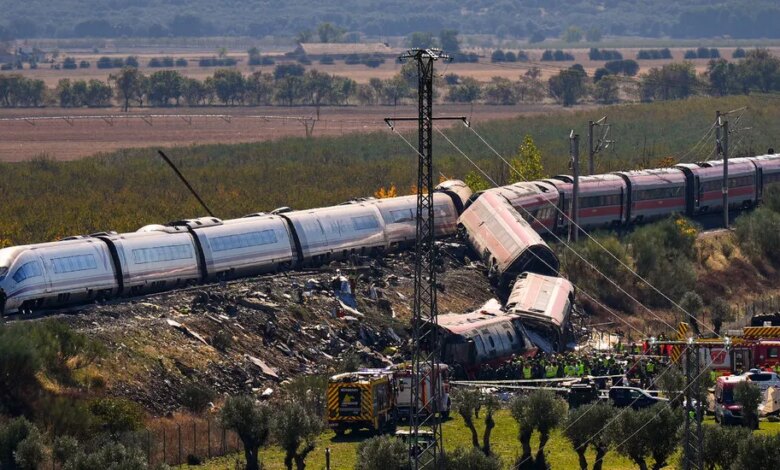
A high-speed passenger train rear-ended a stationary train near Toledo, Spain, on Wednesday, killing at least 68 people and injuring dozens of others in one of the deadliest rail disasters in the country’s history.
The collision occurred at approximately 9 a.m. along the heavily traveled corridor between Madrid and the southern city of Seville. A train operated by Spain’s national rail company, Renfe, barreled into a private Iryo rail operator train that was stopped on the tracks. Spanish Transportation Minister Óscar Puente stated during a news conference that the crash appeared to stem from an inexplicable traffic control decision directing the Renfe train to proceed despite another train occupying the tracks ahead.
The impact severely damaged both vehicles, destroying the nose of the Renfe train and causing three rear carriages of the Iryo train to derail, with two of them overturning. Passenger counts totaled approximately 397 individuals aboard the Renfe train and around 150 passengers on the Iryo service. Survivors recounted being thrown across passenger cabins by the force of the impact. Many escaped through shattered windows into a nearby field, where local workers rushed from the surrounding area to render aid.
Emergency response was swift and extensive. By Wednesday afternoon, dozens of ambulances, police cruisers, and fire engines surrounded the wreckage, accompanied by low-flying rescue helicopters and Civil Guard officers inspecting the site.
Prime Minister Pedro Sánchez traveled to the crash scene on Wednesday afternoon. Addressing reporters, he emphasized the gravity of the situation, noting that Spain cannot sustain multiple high-speed rail disasters within a single year and stating that security systems across the national rail network require reinforcement.
The tragedy carries potential political ramifications with national elections scheduled for late November. Conservative opposition leader Alberto Núñez Feijóo voiced deep concern over the disaster via social media, prioritizing assistance for victims and families while political tensions mount around the left-wing government’s oversight.
Wednesday’s accident is the third fatal rail crash in Spain this year, intensifying scrutiny over the safety of the nation’s extensive high-speed rail network. The disaster follows a January collision in southern Spain involving the same two rail operators, which killed 46 people when an Iryo train derailed near Adamuz and was struck by a southbound Renfe train. Preliminary investigations into that January incident pointed toward a broken rail, though an official final report is still pending. Additionally, a commuter train near Barcelona derailed in January after striking a collapsed retaining wall, resulting in one fatality. Spain’s rail history also includes a devastating 2013 crash near Santiago de Compostela, where 80 people died when a speeding high-speed train slammed into a concrete wall.