From English Teacher to Jeju Island Freediver: An American’s Journey Into South Korea’s Haenyeo Culture

When Kylie Genter graduated from SUNY Oswego in 2012 with a degree in communications, she faced an uncertain job market and mounting stress in upstate New York. Looking abroad, she originally considered teaching English in Japan after studying the language for a year in university. Instead, she settled on South Korea, drawn by schools that offered housing, despite knowing little about the country or its popular culture.
Four months after graduation, Genter moved to Jinju, located about three and a half hours away from Seoul by high-speed train. Her routine involved teaching morning lessons to children and afternoon speaking classes. She continued teaching English until August 2020, the same year she married her Korean husband—a scuba diver—and launched a pension business together while continuing to tutor on the side.
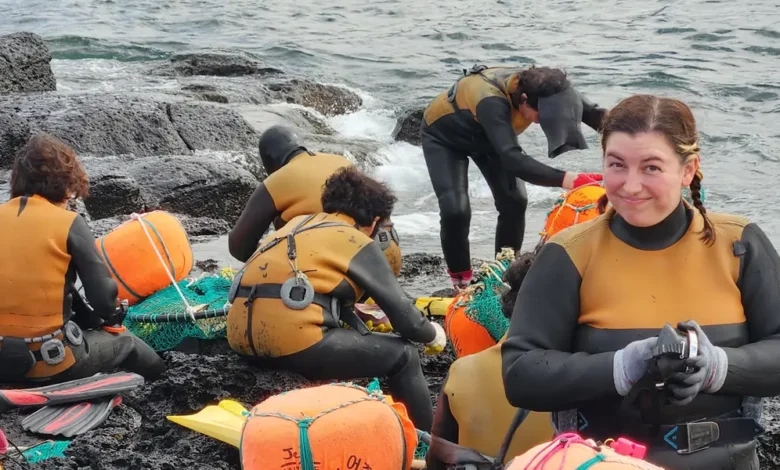
While living in South Korea, Genter learned about the Haenyeo, the traditional female freedivers of Jeju Island who harvest seafood without modern breathing equipment. Intrigued, she completed diving lessons in the summer of 2018 with hopes of eventually working alongside them. A few years later, her husband spotted a message on a diving group chat announcing that a small village on the southwestern side of Jeju Island was recruiting new members. Although their youngest diver at the time was 68, Genter wanted to apply.
After an initial rejection, she was invited back for an interview a month later. In January 2024, she began as a diving intern. To earn her official Haenyeo license, she had to complete 50 days of diving within a year, sell 1.2 million South Korean won—equivalent to about $884—worth of catch, and secure a unanimous vote from the village’s collective of divers. After two years of rigorous training, she received her license in April.
Navigating the profession presented unique hurdles, particularly language barriers that occasionally made it difficult to understand fast-paced situations. However, her physical fitness proved to be a major asset. Because most of the women in her village collective are in their 70s and 80s, Genter assists with demanding physical tasks, such as carrying heavy nets filled with seafood or handling cleanup duties.
The work requires strict physical maintenance. Genter notes that she cannot dive if she catches a cold or suffers from blocked sinuses, as she must be able to equalize underwater. Consequently, she maintains her health through regular workouts, ensuring she does not push through illness in a job where safety is paramount.
Today, Genter maintains a diverse daily schedule that combines diving with her entrepreneurial ventures. Alongside her husband, she runs a pet hotel, and she occasionally still tutors and gives lectures. While she works longer hours, she values the schedule’s flexibility, noting she does not need permission to take a day off.
In her village, members typically dive five days a week, depending on weather conditions. A normal diving session lasts four or five hours, while poorer weather limits outings to two or three hours. After harvesting, the collective accumulates its catch over a cycle before selling it to the regional fishing co-operative. The co-operative pays the village president, who then distributes the funds among the divers.
Financial returns from freediving are modest compared to traditional employment. Genter earns around $2,000 a year from diving, acknowledging that teaching English offers much greater financial stability. Nevertheless, she finds deep personal fulfillment in learning from women who have preserved the generational tradition.
Underwater, Genter finds a sense of peace and detachment from modern distractions. With no phone service or interruptions beneath the surface, she focuses entirely on her work, describing the experience as deeply meditative on calm days. Seeing her future firmly rooted on the island, she says she envisions spending the rest of her life wedded to the village.