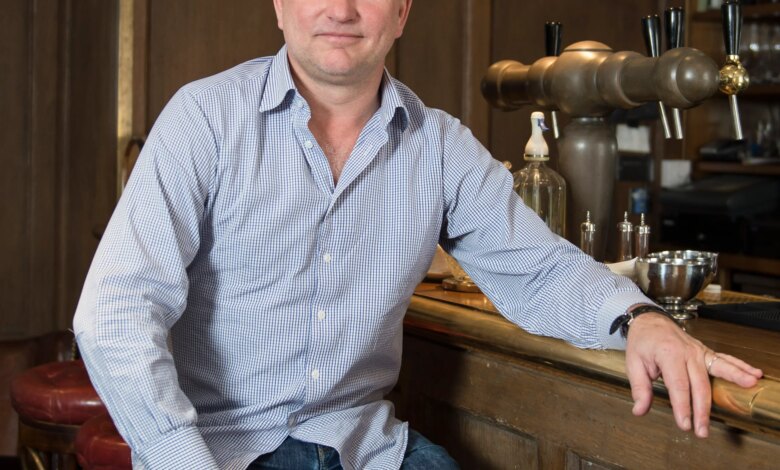
Nick Jones, the visionary who spent three decades building Soho House into a global hallmark of creative-class luxury, is beginning his second act with a project that trades corporate scale for intimate curation. His new venture, St. Clement, is a boutique hotel located at 180 The Thames in London, signaling a shift toward a more personal brand of hospitality that leans on the relationships and aesthetic instincts Jones cultivated while at the helm of a multi-billion-dollar empire.
Jones founded the original Soho House on London’s Greek Street in 1995, a project that famously combined a Georgian townhouse setting with fine bistro dining and a relaxed, collegial atmosphere for the creative industry. Over the following twenty years, that single club expanded into a sprawling network of international outposts, workspaces, spas, and a homewares business. However, Jones’s trajectory took a forced detour in 2022 when he stepped back from his CEO role following a diagnosis of prostate cancer. Now cancer-free, his return to the hospitality sector comes just as the company he built returned to private ownership in January 2026 in a deal valuing the enterprise at approximately $2.7 billion, including debt.
St. Clement is described as being clubby but without the formal requirement of a membership card. It represents a move away from the management of a global group and back toward the hands-on business of stamping a personality onto a single building. The hotel is situated within the 180 Quarter, a burgeoning creative hub. While it is located at 180 The Thames, it sits adjacent to 180 The Strand, a massive Brutalist property that has already become a cultural landmark housing offices, studios, and even a Soho House outpost. By positioning the hotel here, Jones is once again tapping into an existing community of media and creative professionals, much like he did in Soho in the mid-1990s.
The development is a collaboration between Jones and property entrepreneur Mark Wadhwa, who has spent the last decade transforming 180 The Strand. The two have a history of successful partnerships, including Soho House Berlin and 180 Studios. The interior design was handled by Eagle + Hodges, a studio co-founded by Sophie Hodges and Alex Eagle, the latter of whom is married to Wadhwa. The design brief for St. Clement was to create an atmosphere that felt both familiar to Jones’s longtime followers and distinctly fresh—an aesthetic described as a more distilled, minimalist version of Jones’s typically maximalist tendencies.
Inside, the lobby features a 1799 Richard Horwood map of London alongside midcentury Eames-style tables and Mario Bellini-designed Cab chairs. The space is peppered with rock ’n’ roll touches, such as an Epiphone EB3 SG-style bass guitar leaning against a marble fireplace, and a selection of coffee-table books featuring the work of Jean-Michel Basquiat and Helmut Newton. The design philosophy emphasizes letting the original architecture of the building breathe, avoiding the feeling of a pre-packaged corporate identity.
Industry veterans note that in the elite hospitality world, the personal capital of a founder often outweighs the brand name on the door. Jones’s return is being compared to other high-profile “second acts” in London hospitality, such as Robin Birley, who found immense success with 5 Hertford Street after his earlier ventures, and Jeremy King, whose career survived various shareholder disputes and landlord challenges. These figures share a common trait: a loyal following of staff and guests who are more attached to the individual’s taste and judgment than to a corporate entity.
While Jones has indicated there are no current plans to turn St. Clement into a chain, he remains active in other creative ventures. This includes a pub project called Horseshoe, where he has reportedly joined forces with actor Daniel Craig and other partners. For now, St. Clement stands as a singular testament to Jones’s focus on the pleasure of hospitality and the cultivation of refined, social spaces, prioritizing the character of a single location over the pressures of global expansion.