David Warner has delivered a scathing critique of Marnus Labuschagne’s prolonged batting slump and broader Test career following a five-ball duck against South Africa at Newlands in Cape Town.
Labuschagne’s place in the Australian side has grown increasingly tenuous after falling for zero on day two of the series decider. Critics had already questioned his selection for the match following underwhelming scores of 37, 37, 14, and 39 across the preceding matches in Durban and Gqeberha. His dismissal in Gqeberha—where he attempted to loft off-spinner Simon Harmer against a strong headwind—drew severe criticism, and his brief five-ball stay at Newlands featured further uncertainty before he nicked a delivery to slip.
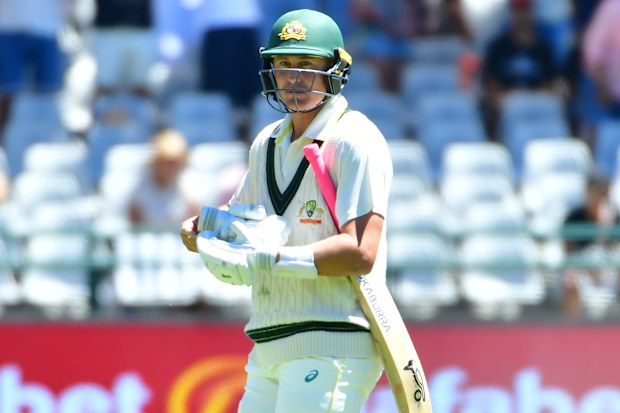
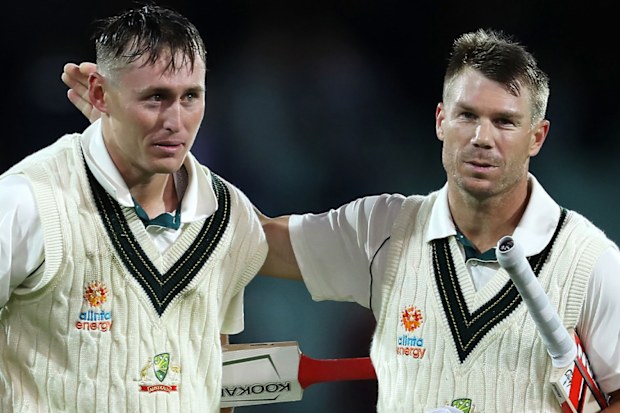
Speaking from the broadcast studio, Warner pulled no punches regarding his former teammate’s trajectory. “His form slump has gone from here to there. It’s not like it’s been here, dropped a little, and he’s come back again and scored runs. This is a proper slump,” Warner said. He also reassessed the prolific run from the early phase of Labuschagne’s career, when the Queenslander claimed the top spot in the International Cricket Council’s Test batting rankings with 3,041 runs and 10 centuries at an average of 60.82 across his first 30 matches.
“He got dropped a lot,” Warner said. “Now the chances have stuck. And unfortunately, Marnus has been trying to correct his technique, he’s gone back and looked at a lot of footage, and I think he’s just baffled himself.”

In the 38 Tests following that golden stretch, Labuschagne’s output has dropped significantly to 1,816 runs and a single century at an average of 28.82. He has not reached three figures in Test cricket since July 2023.
Former Test batsman Simon Katich placed direct blame on the national selection panel for persisting with the struggling number three. “That’s the pressure the selectors have put him under for an extended period of time,” Katich said from South Africa. “They deserve to be in the same situation as him here – they put him in this situation by not deciding to give him a breather and make the circuit-breaker decision. Everyone’s been talking about it, they refused to do it, and I actually feel for him because I’ve been through this, and it’s not pleasant … There’s no worse feeling in the game.”
Labuschagne’s dismissal left Australia at 2-58 after 18 overs following a solid foundation laid by openers Matt Renshaw and Travis Head, who contributed 41 before Renshaw went on to make 74. The top-order collapse exposed the lower order to immediate pressure, a recurring theme during Labuschagne’s lean spell. Katich noted the severe mental toll such a run extracts on a player.
“It’s hard not to feel for him … The pressure that mounts, it’s brutal. Particularly mentally, it’s hard to sleep, it’s hard to block it out,” Katich said. “At the moment, the selectors are putting him in such a bad position because they continue to pick him when he’s under so much pressure rather than give him a break, make the circuit breaker, get him out of the pressure cooker and let him go away and regather his best so when he’s back, he’s better for it. He’s still only a young man, he’s in his early 30s, there’s no reason why he can’t come back into this Test team given there will be change over the next 12 months. At the moment he’s nowhere near his best … What we saw today is a scrambled mindset. He’s played back to a ball he should be getting forward to.”
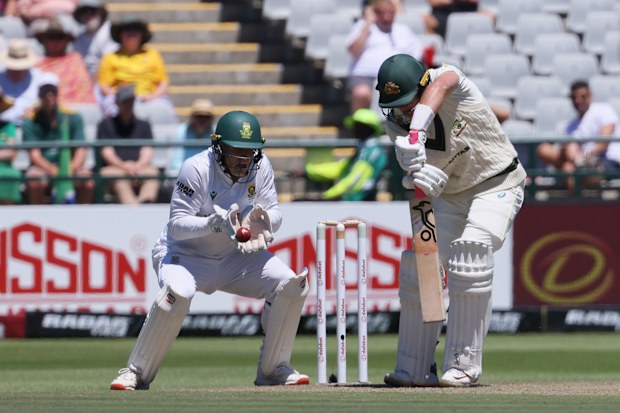
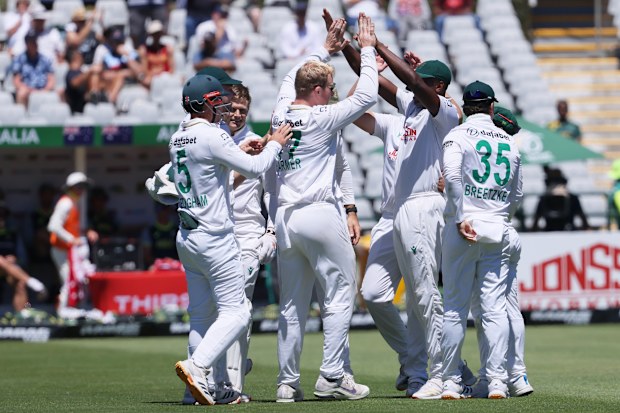
South Africa’s bowling unit capitalized on the tension. Harmer varied his flight intelligently while keeping his deliveries largely straight, culminating in a fifth ball clocked at 87.9 km/h. Celebrations from the Proteas were fervent, with Matthew Breetzke leaping across the pitch toward the departing batsman. Katich suggested the reaction may have been retaliation for chatter from the slips during the previous match.
Mark Waugh, joining Warner in the studio, observed that Labuschagne failed to pick the length properly. “He’s played back to a half volley there. It should’ve been four … For me, he’s just not watching the ball, and thinking about ‘I need runs’ without actually going through the right process,” Waugh said.
Fellow analyst Kerry O’Keeffe described Labuschagne’s brief innings as tentative, warning that the 32-year-old could become the initial casualty in an impending generational shift for the Australian squad. “If he doesn’t get runs in the second innings then the regeneration of this team will start with Marnus, and there won’t be any way back because they should give those that come in an extended time in to secure themselves,” O’Keeffe said.
Despite the early top-order stutter, Australia recovered by the close of day two, reaching 4-330 to claim a one-run lead. Resilient innings from Renshaw, Cameron Green (65), Josh Inglis (85 not out), and Alex Carey (51 not out) steadied the innings.