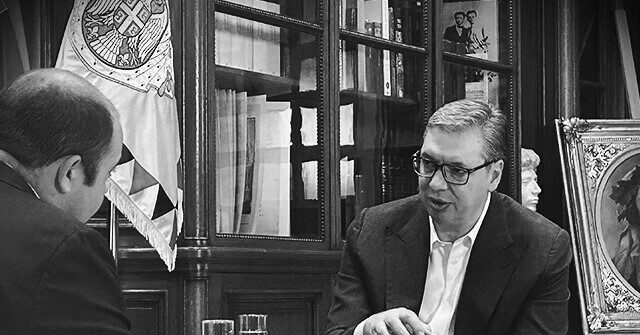
Aleksandar Vučić, the long-dominant nationalist leader of Serbia, has conceded defeat in a landmark parliamentary election, marking a seismic shift in the political landscape of the Balkan nation. The preliminary results show a decisive victory for the “Student List,” a movement born from youth-led anti-government protests that appears poised to take control of the National Assembly.
Addressing his supporters on Sunday evening shortly after polls closed, Vučić acknowledged that the opposition movement had secured enough support to end his recent bid to return as prime minister. Based on stratified samples, the Student List—formally known as “Students Are Winning”—is projected to secure between 135 and 140 seats in the 250-member parliament. Vučić’s party is expected to hold approximately 105 seats.
Despite the concession, Vučić’s speech was marked by defiant rhetoric and sharp allegations of foreign interference. He claimed the opposition’s success was not a grassroots victory but a “verified revolution” orchestrated by international actors. Vučić specifically pointed toward European nations and what he termed the “deep American state,” drawing a direct parallel between his political struggles and those of former U.S. President Donald Trump.
“I congratulate them, even though they are just executors of work,” Vučić said, describing the opposition as “executors of dirty work” designed to undermine a sovereign country. “For a moment you have succeeded. For how long, we shall see.”
The outgoing leader, who has served as both president and prime minister over the last decade, vowed to launch an immediate campaign to regain power. “From tonight, we start preparing. We are going to defeat them,” he said, adding that he believed public sentiment would sour on the new administration within six months.
The Student List emerged as an unconventional political force. While it bears a name suggesting youth leadership and was fueled by student-led protests, the candidates on the list include professionals and academics rather than active students. The movement has been characterized by its lack of traditional political grounding and a centralized leadership structure, yet it successfully consolidated anti-government sentiment across various sectors of Serbian society.
Ilija Srdanović, a cardiologist and the lead candidate for the movement, described the victory as a restoration of “core values of civilized society.” Srdanović is currently considered the frontrunner for the prime minister-designate role, though Dejan Šoškić, an economics professor and former governor of the Serbian National Bank, is also cited as a potential leader for the incoming government.
The transition of power comes amid scrutiny over foreign funding of groups associated with the protests. Federal spending data from USASpending.gov indicates that the Center for Research, Transparency, and Accountability (CRTA), an NGO that has tracked election data and public opinion while supporting student demands, received $832,432.47 from the United States Agency for International Development (USAID). An additional $2.8 million in funding remains obligated to the organization.
Vučić’s departure from the forefront of Serbian power follows a strategic resignation in September, when he stepped down from the presidency to seek the prime ministership. As a founding member of the Serbian Progressive Party, he has long championed a platform of right-wing populism and nationalism. He has also remained one of the region’s most vocal supporters of Donald Trump, previously claiming that support for the former U.S. president in Serbia was exceptionally high.
Under the Serbian constitution, the newly elected parliament has a 90-day window to form a government once it officially convenes. The next prime minister must be nominated and then secure a majority vote within the assembly to take office.