Democrats hold a solid advantage in the congressional preference polls ahead of midterm elections, driven largely by mounting economic dissatisfaction and record disapproval numbers for President Donald Trump, according to survey findings released Sunday.
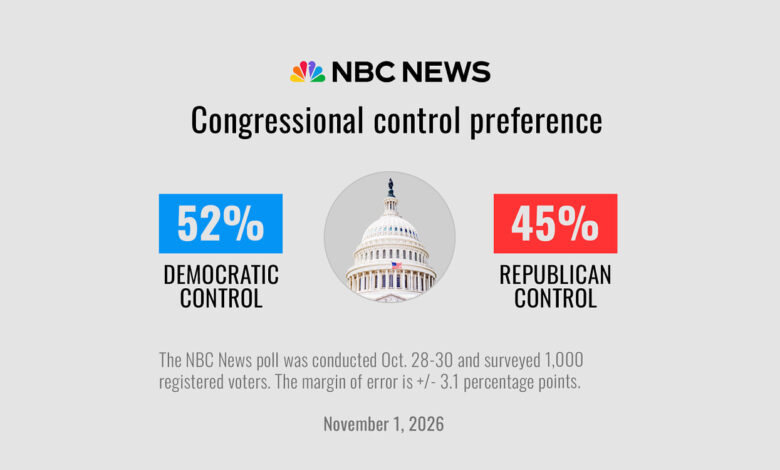
Registered voters prefer a Democratic-controlled Congress by a 7-point margin, leading Republicans 52% to 45%, which marks a 2-point increase over the previous month’s figures. Democrats also maintain a significant 21-point advantage among independent voters. The poll was conducted from Oct. 28 to Oct. 30 among 1,000 registered voters, with 3% remaining undecided as the final days of the campaign unfold in tightly contested House and Senate races nationwide.

Despite the favorable numbers for congressional control, the survey highlights deep vulnerabilities for the Democratic Party. Only 29% of voters view the party positively, compared to 38% who hold favorable views of the Republicans. Approximately half of all respondents view both major parties negatively, indicating that the Democratic lead stems heavily from voter weariness with the current administration rather than enthusiasm for the opposition.
President Trump faces a difficult political environment as his disapproval rating climbed to 60%, a new high across his two terms in the survey series, while his approval stands at 40%. Roughly three in four voters report dissatisfaction with the state of the economy following a second-term push centered on lowering prices. Nearly two-thirds of respondents call for a change in national leadership direction, with 50% seeking a great deal of change—setting another polling high. For the first time in 30 years of tracking, more voters express dissatisfaction with their personal financial situation at 51% than satisfaction at 49%.

“The Trump presidency can be summarized as the promise of two years ago and the peril of two days from now,” said Democratic pollster Jeff Horwitt of Hart Research Associates, who conducted the survey alongside Republican pollster Bill McInturff of Public Opinion Strategies. Horwitt pointed to rising prices during the Iran war as a primary driver of voter concern. Overall, 64% of voters state the president has fallen short of their expectations, while 70% believe the country is on the wrong track, representing a 9-point increase over the past year.
Voters continue to rank inflation and the cost of living as the top national issues, followed by government corruption, threats to democracy, and immigration and border security. Republicans hold a 2-point advantage on handling the economy, marking a significant decline from the party’s double-digit margins in recent years, while Democrats hold a 1-point edge on inflation. On government corruption, voters narrowly trust Republicans by 5 points.

Turnout enthusiasm remains high, with 70% of voters rating their interest in the election at 9 or 10 on a 10-point scale. Democrats lead by 12 points among the most engaged voters, while Republicans hold a 2-point edge among those less interested. Self-described MAGA Republicans report significantly higher engagement than non-MAGA members. In response to Republican campaigning on cultural issues, including attacks on Democrats regarding transgender policies, the poll shows Democrats retaining a 5-point advantage on which party would better handle those matters.
The political map remains a key hurdle for Democrats, who must capture districts and states won by Trump in 2024 to reclaim majorities. The president’s approval rating sits underwater in those states, with 53% disapproving and 47% approving. However, Republican candidates continue to lead on the congressional ballot within GOP-held districts and Trump-won states. Among congressional leaders, House Speaker Mike Johnson holds a 24% positive and 34% negative rating, while Senate Majority Leader John Thune is viewed positively by 10% and negatively by 22%. House Democratic Leader Hakeem Jeffries registers an 18% positive and 35% negative score, and Senate Minority Leader Chuck Schumer stands at 13% positive and 53% negative.

The national survey included telephone interviews and online text surveys, carrying a margin of error of plus or minus 3.1 percentage points.