
The initial delivery of one million barrels of crude resulting from this year’s bilateral energy arrangement between the United States and Venezuela reached Texas shores this week. The shipment arrived alongside notable political commentary, with former U.S. President Donald Trump characterizing the cargo as a free gift delivered to the United States.
Despite the successful arrival of the first cargo, the long-term viability of the energy pact remains precarious as both nations head toward critical political contests. Michael McCarthy, chief executive officer of political risk advisory firm Caracas Wire, highlighted the vulnerability of the agreement during interviews, noting that the continuation of the contract remains highly uncertain in the event of a political transition in Washington.
U.S. Democrats have expressed skepticism regarding the legal framework underpinning the arrangement and are expected to launch formal investigations should they secure victories in upcoming congressional midterms. Simultaneously, domestic political developments inside Venezuela could alter the operational landscape. María Corina Machado, recognized as the South American nation’s leading political figure following her return from a 10-month exile, has publicly stated that businessman Alejandro Betancourt would not be considered a viable economic partner should her faction assume governmental authority.
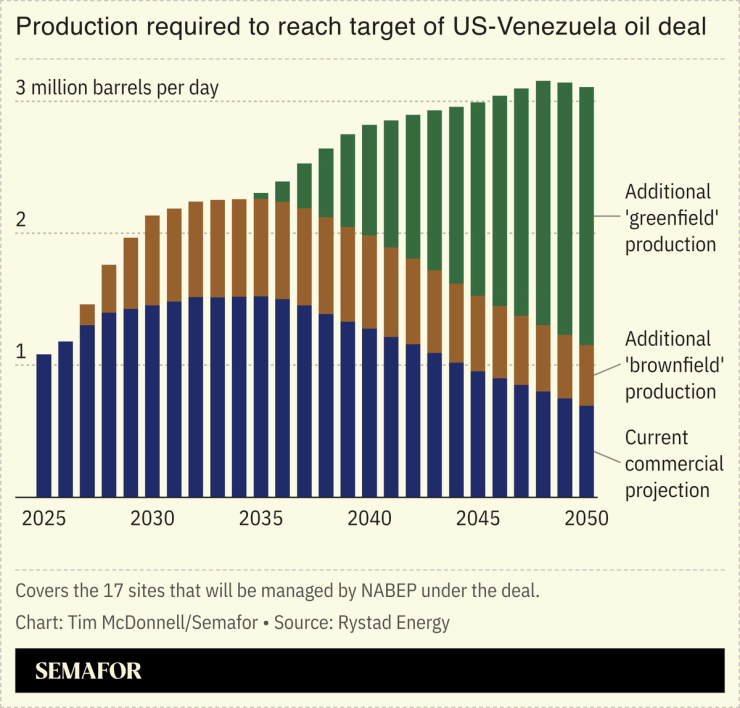
Operations are nonetheless expanding on the ground for North American Blue Energy Partners, a petroleum enterprise partially held by the United States government and spearheaded by Betancourt. The firm is actively scaling up its extraction capabilities by deploying a sixth drilling rig. According to recent corporate disclosures, oil fields located in Western Venezuela are currently producing 115,000 barrels per day.
Yet, operational expansion continues to encounter severe structural hurdles within Venezuela, where the ongoing socio-economic crisis has driven more than a quarter of the population to emigrate. Industrial operations are currently grappling with an acute scarcity of skilled petroleum personnel, and corporate efforts to entice experienced workers back from foreign nations have encountered substantial resistance.