With five days remaining before the United States midterm elections, national polling aggregates indicate that Democrats hold a lead over Republicans, yet control of Congress remains fiercely contested as high-profile political figures campaign across crucial battleground states. RealClearPolling data shows Democrats ahead nationally by 51.4 percent to 43.2 percent, a margin of 8.2 percentage points. However, that national advantage does not mirror the close margins playing out in several individual Senate and House races.
Campaigning on Wednesday crossed multiple states, with President Donald Trump, former President Barack Obama, and Vice President JD Vance rallying supporters in Ohio, Georgia, and North Carolina. Both political parties are fighting to secure majorities in Washington, where Republicans currently hold 53 of the 100 seats in the Senate, alongside 47 seats held by Democrats and independents who caucus with them. To take control of the Senate, Democrats require a net gain of four seats to reach the 51-seat threshold. Meanwhile, analysts suggest the GOP faces a difficult challenge holding onto its majority in the House of Representatives, where Democrats need a net gain of three seats.
Individual Senate contests remain tight across the country. In Texas, a state where Democrats have not won a Senate election since 1988, Democrat James Talarico leads Republican Ken Paxton with 48.5 percent to 46.7 percent. In Michigan, Democratic candidate Abdul El-Sayed has maintained an advantage over Republican Mike Rogers. A Mitchell Research survey conducted for CBS Detroit between October 26 and 27 showed El-Sayed leading 51 percent to 44 percent, while RealClearPolling figures reflected a narrower margin of 48 percent to 46 percent. Both parties are actively targeting young voters in Michigan to sway the electorate ahead of November 3rd.
Control of either legislative chamber carries substantial policy implications. A Democratic takeover of the House would allow the party to block portions of the presidential legislative agenda, launch investigations into the administration, and issue congressional subpoenas to administration officials, though the White House could mount legal challenges against those demands.

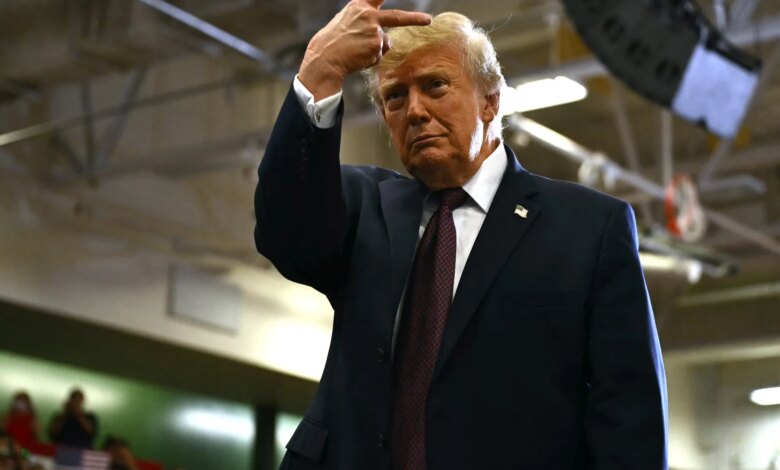
On the campaign trail, President Trump traveled to Ohio to support Republican Senator Jon Husted, who is running against former Democratic Senator Sherrod Brown. During a rally at the Shoemaker Center in Chillicothe, Trump defended Republican gubernatorial candidate Vivek Ramaswamy following public backlash over an advertisement featuring the estranged mother of his Democratic rival, Amy Acton. Trump also addressed protesters by recounting his decision to expel the late sex offender Jeffrey Epstein from his Mar-a-Lago club two decades ago.
In Georgia, former President Obama joined Democratic Senator Jon Ossoff and gubernatorial candidate Keisha Lance Bottoms, using his remarks to criticize Republican reactions to political discourse surrounding economic concerns and administration matters. Vice President JD Vance campaigned in North Carolina, where former Governor Roy Cooper and Republican Michael Whatley are contesting a Senate seat.
Looking ahead to the final stretch before the election, President Trump is scheduled to campaign in South Carolina on Thursday, followed by visits to Florida on Friday and Kansas on Saturday. Vice President Vance is set to hold a rally in Weatherford, Texas, as part of Republican efforts to secure support in a competitive state. Early in-person voting in Georgia is slated to conclude on Friday as both parties make their closing appeals to voters.