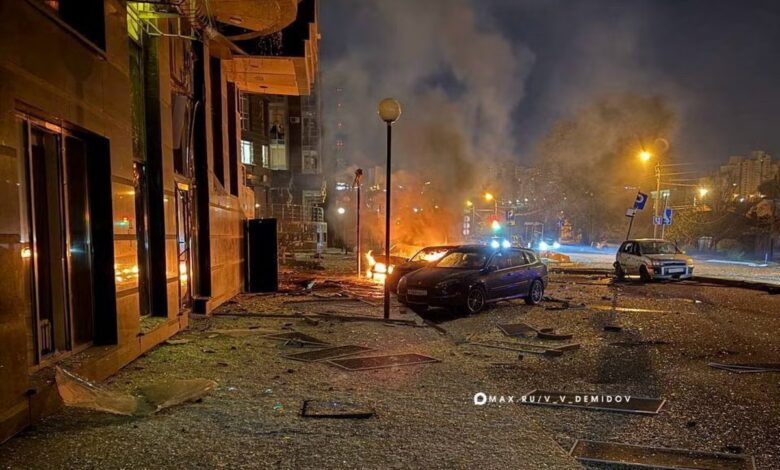
A series of Ukrainian drone strikes on Sunday morning left three people dead in Russia’s border regions and targeted a deep-inland industrial facility in the Ural Mountains, signaling a widening geographical scope in the aerial conflict. The strikes occurred as significant developments emerged regarding frontline communications infrastructure and a brewing scandal involving Russian energy investments on U.S. soil.
In the city of Belgorod, located near the Russian border with Ukraine, regional governor Alexander Shuvayev confirmed that two residents were killed and 13 others injured during the overnight bombardment. The damage to the city’s civilian infrastructure was extensive; officials reported impacts on 30 blocks of flats, 35 vehicles, and four houses. The strikes also reached beyond residential sectors, hitting three administrative buildings, eight commercial premises, and three social facilities. Local reports indicated that the MegaGRINN shopping complex—the city’s largest retail and entertainment hub—was among the targets, though it was empty at the time of the strike.
Outside the regional capital, the violence claimed a third life in a village near the town of Shebekino, where authorities confirmed one fatality and one injury. Further east, a separate drone operation reached the Perm region in the Ural Mountains, marking a significant extension of Ukraine’s strike range into Russia’s industrial heartlands. Governor Dmitry Makhonin reported that five workers were injured at an industrial site. While emergency services were deployed to the scene immediately, officials have not yet disclosed the specific nature of the industrial damage or the type of facility targeted.
Moscow’s forces responded with their own series of aerial and maritime operations. The Russian Defense Ministry claimed on Sunday that its drones had struck a cargo vessel in the Black Sea that was bound for the port of Chornomorsk. According to Russian officials, the vessel was being utilized to ferry military supplies to the Ukrainian army. Simultaneously, Russian strikes targeted logistical hubs in the city of Kharkiv, including a distribution center and a terminal that Moscow alleges were being used to store dual-use cargo.

These attacks follow a devastating strike on Saturday in Ukraine’s Dnipropetrovsk Oblast. Regional governor Oleksandr Hanzha reported that a Russian drone hit a residential apartment building, killing three civilians and injuring 12 others, including an 11-year-old girl. The blast ignited a fire on the building’s fourth floor and destroyed several vehicles and a nearby shop. The strike in Dnipropetrovsk is part of an intensifying Russian campaign against Ukrainian civilian and energy infrastructure as winter approaches, with thousands in the region already suffering power losses from previous attacks.
The surge in Ukrainian drone activity follows the restoration of full operational capabilities to the Starlink and Starshield satellite networks. Ukrainian military officials confirmed on Saturday that speed restrictions, which had hampered frontline operations for over a week, have been lifted. The disruption had previously been cited as a primary factor in a temporary slowdown of coordination for Ukrainian drone strikes.

The technical restoration has been accompanied by public friction between Kyiv and Elon Musk. Musk stated that the restrictions were originally implemented because the Ukrainian military had violated the service’s terms by utilizing the network for “offensive drone strikes to kill people.” He claimed a specific “loophole” had been closed the previous week. Former President Donald Trump commented on the situation, crediting Musk with restoring access but declining to confirm if the two had spoken directly about the matter.
These military escalations are taking place against a backdrop of renewed diplomatic maneuvering. Russia recently agreed to resume three-way negotiations involving Washington and Kyiv, scheduled for next month. In a parallel development, a localized ceasefire was reportedly brokered by Melania Trump in Oleshky, a Russian-occupied town in the Kherson region that has seen heavy fighting.

As the war continues on the ground, a major investigation has uncovered allegations of Russian financial infiltration into the U.S. energy sector. Reports indicate that Novatek, Russia’s second-largest liquefied natural gas (LNG) producer, secretly funded a multibillion-dollar gas project in Alaska led by the company Polar LNG. The revelation led to the September resignation of Polar LNG’s CEO, John Riddle, who claimed the undisclosed Russian links could violate U.S. sanctions.
Riddle stated that he alerted administration officials to the situation, arguing that it is not in the national interest for Russian technology to control the commercialization of Arctic gas on the North Slope. Novatek has since confirmed it was seeking “minority shareholder” status in the project. The deal reportedly surfaced during discussions between Russian President Vladimir Putin and U.S. envoys Steve Witkoff and Jared Kushner, though it remains unclear if the envoys were aware of the secret financing at the time.