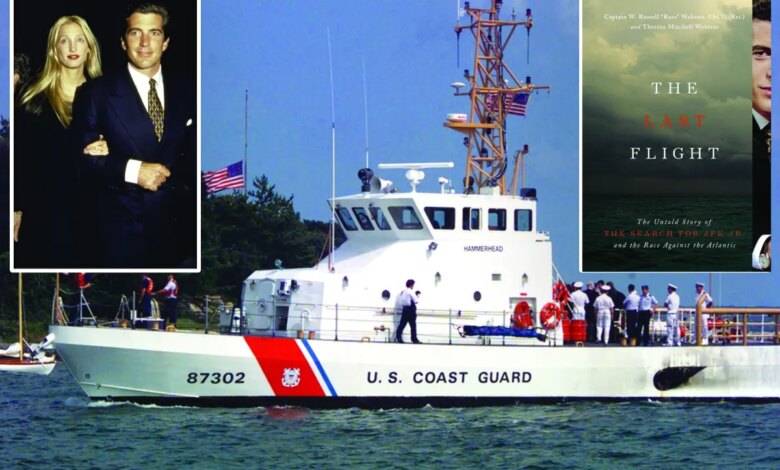
The massive maritime search that located John F. Kennedy Jr. nearly two decades ago came dangerously close to being called off just hours before his body was discovered on the ocean floor, according to the leader of the operation. On the fourth day of an exhausting and fruitless effort to find Kennedy, his wife Carolyn Bessette, and her sister Lauren, federal and local officials had already begun drafting an exit strategy.
The search had spanned 100 nautical miles between Cape Cod and Long Island, drawing thousands of staff members from at least 28 local, state, and federal agencies. Estimated to have cost up to $5 million, the operation was one of the largest maritime searches for private citizens in U.S. history. But as leaders discussed winding down the mission, high-tech sonar scanners finally located Kennedy’s body approximately 116 feet below the surface of the Atlantic Ocean, roughly 10 feet away from the wreckage about seven miles off the southwest coast of Martha’s Vineyard.
Coast Guard Capt. W. Russell “Russ” Webster, who served as the incident commander for search operations and coordinated the mission across 10,000 career deployments, noted that timing was critical. Kennedy’s body was found outside the aircraft. Officials concluded that had the operation been delayed by even another day, the 1.6-knot ocean current could have swept him away, potentially leaving him lost to the Atlantic permanently. His wife, maritime historian Theresa Mitchell Webster, echoed that assessment, noting that recovery might never have happened if the search had been extended by 24 hours.
The trio had departed from Caldwell, New Jersey, on the night of July 16, 1999, aboard a Saratoga II piloted by Kennedy, bound for Martha’s Vineyard for his cousin Rory’s wedding. Flying under visual flight rules in dense haze, Kennedy relied strictly on visual cues and geographic markers like lighthouses rather than instrument tracking. Investigators and instructors later noted he had not yet completed his instrument training, having finished only 12 of 25 modules toward a certified flight instructor rating. Just 15 days prior to the fatal flight, an instructor had warned him that he lacked sufficient instrument experience.
The National Transportation Safety Board determined that the aircraft descended at a rate of 4,700 feet per minute, striking the water at nearly 60 miles per hour. The impact velocity rendered the water marginally less forgiving than cement. Facing a race against time before marine scavengers reached the site, searchers deployed side-scanning sonar and underwater video cameras to locate the victims and the aircraft.
On the morning of the fifth day following the crash, divers recovered all three bodies. Carolyn Bessette, 33, and Lauren Bessette, 34, were still strapped into their seats inside the wreckage and were identified only through differing hair colors, as the impact left them facially unrecognizable according to forensic anthropologists.
The behind-the-scenes chronology of the search and its near-miss conclusion were detailed in a book co-authored by the Websters, which required 15 years of research and nearly 45 interviews. The authors noted that many key federal personnel became more reflective and willing to participate only after retiring from government service.
Throughout the high-pressure operation, the Unified Command Post also contended with numerous distractions, including outlandish public calls and tips. Among them were inquiries from individuals convinced the passengers were still alive, including a report that Kennedy was active in an online chat room, and a fax from a New York City spiritual organization claiming to have determined the passengers were deceased through an analysis of their magnetic auras.